• Discover boat-in spots from Sucia’s anchorages to the trails of Stuart and Jones Island
• Experience the Islands
• Visit bustling Friday and Roche Harbors
• Find serene, secret coves • Your adventure begins now!
New Feature
Below every post is a satellite view hot link - You may drag image to your area and/or use the plus button to zoom in all the way or click street view when enabled.
++++ ============================= All Posts Below
Current Posts Below Note: The first few posts below are for first timers and stay on top — New posts are scattered throughout the website — use the search box or look in archives on the left side to find your interests
See for yourself. Matia Island pictorial by land and sea
A few years back, I hiked the trail from Pelican Beach to the top of Eagle Bluff on Cypress Island, taking pictures every few minutes along the way.
The resulting pictorial is a pretty good synopsis for those who can't make the journey themselves. See the Eagle Bluff Pictorial hike here.
I decided to do the same thing on Matia, but with a little change-up.
First, I hiked the trail snapping away with wild abandon, then I jumped in the dinghy and hugged the shore, continuing to take pictures while I circled the island. Then I deleted most of what I had. The results are below; you decide if it was worthwhile.
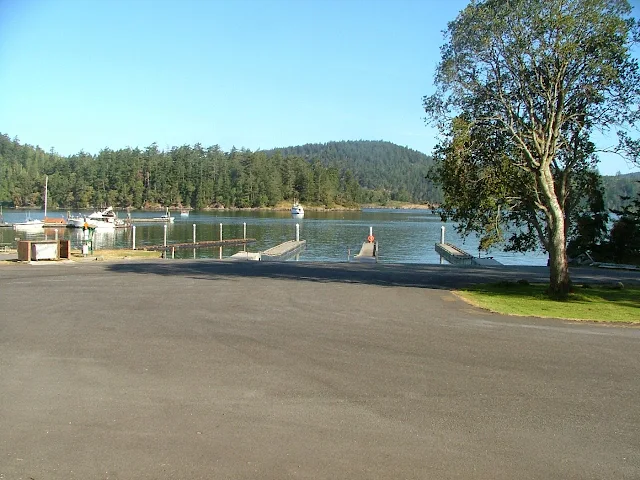
The blue marker on the far left marks Rolfe cove, and where we begin our visit to Matia
First off, exit the dock!
The little four-boat float may be full, but there are two buoys and room for a few boats to anchor. In a pinch, you can anchor in the much larger cove at the other end of the island and do this hike/dinghy tour in reverse.
Boater park fees are a great deal for what we get in return.
The trail starts at the top of ramp beyond the small picnic campground area. Matia is unique in that fires are not allowed anywhere, and pets are restricted from trail system.
click where it says read more for the rest of the picture tour!
What are little known places in the San Juan Islands?
Everyone knows about Rosario - Friday Harbor - Roche Harbor and Sucia Island. Of course, they are famous and not to be missed.
But some of the best San Juan area destinations are much less traveled. And even less talked about.
Out of the way places have secrets where a little local knowledge may turn a ho-hum cruise into a truly memorable event. I am listing and describing some of our favorites, feel free to make them yours too.
Not in any order or preference!
#1Saddlebag Island
At the top of Guemes Channel northeast of Anacortes in Padilla Bay is diminutive Saddlebag Island State Park.
Saddlebag has only 24 acres, its distinctive dog-bone shape creates two teeny bays. The north one suitable for two anchored boats, or only one if the skipper hogs the middle on a long rode. We have always been able to anchor fifty feet from shore. The dinghy ride is short and sweet, the gravel beach is friendly and steep. The bay catches a little flotsam and wayward seaweed so an aroma may be mixed in with treasures you find.
The narrow center isthmus holds a small campground and outhouse (newer). Hiking the shoreline trail is easy and follows a handy figure eight shape affording views in all directions. Being less than two miles from Anacortes makes Saddlebag an easy kayak destination.
The waters on the east side of Saddlebag are shallow and rock strewn, circling the island is a white-knuckle event at lower tides. Your dinghy or kayak would be a better choice than the mother ship if you are determined to gunk-hole.
We stop at Saddlebag for lunch and a hike, overnight if it is late, or just a quick anchor and hike. We always see something new, and never go away unhappy.
Saddlebag may only be rated as five star, you will be glad you stopped by.
Where are the marine parks of the San Juan Islands?
Below is the marine parks list, followed by reviews, charts, and pictures.
This is not all the parks, just the ones you may want to make part of your cruising. It's unlikely you can visit all in one trip and still do a decent job of sightseeing. You should plan multiple visits to the San Juans.
Many people choose Jones as their favorite for just hanging out for a few days, so Jones is first. For hiking, Sucia, or Pelican Beach on Cypress Island are the best, but all the parks have hiking trails.
Some parks are in a convenient location when you need to spend the night and you're between destinations, Saddle Bag, Eagle Harbor, and Odlin would fit this description.
Most parks with docks have picnic tables on the floats, which are very handy for extending your living area, socializing, and meeting other boaters.
For marinas/etc. where you can get fuel and provisions
What is a good nine-day itinerary for cruising the San Juan Islands?
A good nine-day San Juan Islands itinerary includes a mix of marine
parks, scenic anchorages, and moorages such as Friday Harbor and Roche
Harbor.Matia Island, Sucia Island, and Jones Island are popular stops.
This extended cruising plan allows time for hiking, exploring, and adjusting
routes based on weather and currents rather than rushing between destinations.
Suggested Itineraries for a first-time boat trip to the
San Juan Islands
(Updated (2014) alternate itinerary with Echo Bay and Sucia Island as 1st stop)
Friday Harbor is just one of many places where cruisers can access towns and shore amenities. For more options, see our list of public-use docks around the San Juan Islands.“public-use docks around the San Juan Islands”
What are some lesser-known places to visit in the San Juan Islands?
Some of the best, but less well-known San Juan Islands destinations include:
Matia Island’s rainforest trail
Eagle Bluff on Cypress Island
Turn Point Lighthouse on Stuart Island
Vendovi Island Preserve.
This article highlights fifteen unique stops—from quiet anchorages to scenic hikes—helping boaters and visitors discover uncrowded places beyond popular harbors like Friday Harbor.
These are special places to go and great things to do that our years of cruising in the San Juans have rewarded us with.
Friday Harbor - Turtleback Mountain - Jones Island - Sculpture Park at Roche Harbor - Youngs Hill - Turn Point Lighthouse - China Caves - Matia Island Rain Forest Trail - Patos Island Lighthouse Tour - Inati Bay & Lummi Island Campground - Vendovi Island Preserve - Eagle Bluff On Cypress - Fort Whitman On Goat Island - Rosario Beach & The Maiden of Deception Pass - Victoria & Butchart Gardens
Some of the very best places are walks or hikes that are off the beaten path and seldom visited. I have listed them in somewhat of a great circle to help you stay oriented, but you will not be able to visit all of them in one day. I suggest that you mark them on a paper map or chart for later reference.
Our experience has shown us that trying to visit too many places in a single cruise is overly tiring and diminishes the entire trip. Plan a relaxing itinerary and take your time
Check out these places too. Not really must see places but still wonderful exploring and gunkholing places.little coves and back doors
What and where are the San Juan Islands' ten best parks?
Let's start by listing my choices in order of best first, first because they have overnight docks, followed by some pros and cons, and a few real-world comments. (Hopefully, I haven't omitted your favorite) Keep in mind, we go to all the parks and don't dislike any but there is no doubt some parks are five-star and some are not, depending on what we are doing or the weather during that particular cruise.
For a more detailed review of the San Juan area marine parks, including maps try this post. marine parks
parks with docks
Jones Island
Matia
Sucia - Fossil Bay
James Island
Stuart Island (Prevost & Reid Harbor)
Sharpe Cove and Cornet Bay at Deception Pass
parks without docks
Saddlebag Island
Pelican Beach
Turn Island
Eagle Harbor
Cypress Head
Patos
Sucia (Echo and Shallow bays)
Spencer Spit
Odlin County Park (has 2 hr dock)
Clark Island
Doe Island
Obstruction Pass
Sidney Spit Marine Park (Canada) (has overnight dock)
Washington Park (launching ramp only dock)
San Juan County Park
Shaw Island Park
1 - Jones Island is my number one choice and here's why
Pros:
bigger but not the biggest dock
protected bay
great dinghy beach with a couple of tidepools
anchor buoys and lots of room to anchor
running water and four nice nearby composters
Hiking the many loop trails at Jones never gets boring
tiny deer, many tame, are unique to Jones
dock is very close to camp sites for evening fires
Where are the off-the-beaten-path and hidden gems of the San Juan Islands?
It's easy to go to the marine parks and jostle with the other boaters at the dock or scramble amongst a minefield of anchors and buoys. Sometimes seclusion and communing with nature is simply a matter of going around the point.
Low tide and still lots of water for anchoring, but open to swell from Rosario Strait.
As with all gunkholing and exploring, you must be vigilant, watch for rocks, know your tide range and proceed dead slow or pay the price. Speaking of paying >>> paying the price Suggested backdoors, (none preferred over another) and places to get away from other boaters.
Matia Island: Matia Cove is a fairly long indent (see pic) at the east end of the island and holds several boats. An unnamed cove is just around the corner from Rolfe Cove where Matias dock is located. Both these coves offer anchorage away from the usual hustle and bustle.
Sucia Island: Snoring Bay is between Echo Bay and Fossil Bay on Sucia and Ewing Cove is accessed via Echo bay on the northeast side. Both coves offer access to the Sucia trail system, and may have anchor buoys still intact.
Saddlebag Island: This state park is so little visited, you may consider the entire island a backdoor, but there is a second minor cove on the south side with a great view of Cap Sante should the northside be full up.
Inati Bay on Lummi Island is located on the southeast side of Lummi Island. This medium size cove holds a handful of boats and is a perfect storm refuge when you are caught on your way to or from Squalicum Harbor.
Cypress Head: The normally used cove with anchoring and buoys is on the north side of the isthmus and open to passing wakes, but the long cove on the south side of the isthmus is easily navigated and may be calm. Watch your depth here.
Doe Island State Park: The last we looked (2015) the float was still gone but you can anchor here in relative peace and protection.
East Sound: If you're at Eastsound (the city) and it gets dark, you can anchor in Judd Bay on the far north end (left side) of East Sound. You will be a long dinghy ride from the Eastsound dock, which does not allow overnighting. Anchoring near the county dock is liable to be rolly after dark.
Roche Harbor: If crowds drive you bonkers and you want to run away, just run two miles to Westcott or Garrison Bay. Anchor anywhere but watch your depth and don't block access. You wont be totally secluded or alone, but you will be away from the mob at Roche.
Smallpox Bay: This small bay is on the Haro Strait side of San Juan Island just a few miles south of Roche Harbor (scoot through Mosquito Pass) it's a dinghy ride to shore at this San Juan County Park where campers watch for orca's.
There are lots more hidden places, too many to list but you can use the search box for them. Search - coves, bays, anchoring, camping, parks, things to do, places to go, etc.
You can anchor off to one side virtually anywhere but you may suffer wakes. I left out well known places like Blind Bay, Fisherman Bay, Parks Bay. which will all be crowded. I wanted to suggest mostly secluded easily overlooked locations that will be appreciated by the discerning recluse.
What are the best things to do and places to visit in the San Juan Islands?
The Islands are best experienced by combining visits to marine parks, time in small towns, and time on the water.
The best things to do in the San Juan Islands include visiting marine parks like Sucia and Jones Island, exploring towns such as Friday Harbor, and enjoying boating, fishing, hiking, and wildlife viewing. Popular destinations combine scenic anchorages, walking trails, and shore access, making it easy to plan a balanced trip with both relaxation and activity.
Explore hidden coves and discover the best things to do in your boat while cruising the Salish Sea
The difference between a truly wonderful vacation and a ho-hum boat ride is the memorable experiences and special places visited along the way. These are some of our favorite haunts and things to do. Maybe some will become your favorites as well.
Matia Island one-mile loop trail
This easy one-mile loop immerses you deeply into the shaded forest the minute you take your first steps. Towering trees, oversized ferns, and thick mosses line the trail. Our first walk many years ago was so serene and calming that even our young kids were quiet and talked in whispers. Matia Island pictorial
Pygmy deer on Jones Island
The northwest is full of wildlife and deer are everywhere, or so it seems sometimes. However, apparently, the many deer on Jones Island have developed to a much smaller size. Even the older bucks with big racks are only about waist-high. Many of the deer are tame, and some are downright annoying. One time a deer met me at the water's edge as I came ashore in the dinghy. Several times deer have joined us around our campfires looking for handouts and letting the kids rub their heads and pet them. I remember once a spike kept crowding too close to the fire, he was intent on getting at a bag of corn curls. It is against park rules to feed the animals so I don't know how they learned to expect treats from boaters. Jones Island deer
Deception Pass State Park
While Deception Pass isn't located within San Juan County, any boating enthusiast would be remiss not to include it in their cruising itinerary. In fact, Cornet Bay, with its well-facilitated ramp, serves as a prime launch point for those embarking on their nautical adventures. But, here's a piece of advice – don't just launch and rush through; take the time to savor the breathtaking scenery.
Consider planning part of your voyage around the four daily occurrences of slack tide. At slack tide, the turbulent waters temporarily calm, providing an excellent opportunity for exploration. A mere quarter-mile beyond the pass, still within the park's boundaries, you'll discover Sharpe Cove. Here, you can moor your vessel at the floating dock, and at the head of the ramp stands the remarkable Maiden of Deception Pass.
What is a good place to begin a boat trip to the parks of the San Juan Islands?
There are three choices for where to launch:
Cornet Bay in Deception Pass Park
Washington Park in Anacortes
Squalicum Harbor in Bellingham
Matia Island
This post is written to help new cruisers headed to the San Juan's needing the same simple answers we needed.
From time to time, I refresh my thinking and remember our first visit nearly thirty years ago. Specifically, what a pain it was not knowing the simplest answers to questions we take for granted today.
I define the San Juan cruising area not by county or even country, but rather by places we want to visit and spend some time. But that also means, places we have the capability to get to without too much effort or time. So that being stated, I think of Port Townsend and Deception Pass Park (Cornet Bay), and Swinomish Channel as our loosely defined southern boundary. I think of Vancouver BC and Nanaimo as our northern most point, and everything in between Vancouver Island and the mainland completing the east west box. Keep in mind, with a day or two extra, you can run down to Olympia or up to Princess Louisa Inlet.
For this discussion, we are sticking to the
core San Juan Island area and what you need to get there.
You need a boat, but you can rent a sail or powerboat in Anacortes or Bellingham if you prefer, and it doesn't take much experience to qualify.
Size matters? yes and no. Bigger is more comfy, costly and feels imminently safer in a storm. As size goes up, so do your skill requirements. Once past about thirty five feet you will find you don't fit at some docks and fuel burns at over twenty five gallons an hour. Smaller is better at times. Eighteen foot ski and fishing boats or day sailors are very easy to get in and out at virtually all places but with all your food and gear, you could be crowded on board. When packing and provisioning, be honest and admit you don't really need all that stuff you take car camping. Above all, don't let your lack of a perfect boat cause you not to go. Take what you have, you can make it work.
Bring a dinghy, even a two person inflatable kayak is okay. You need a way to get to shore where there are no docks. You don't have to carry the dinghy on board, you can tow it everywhere you go. Yes you can beach your runabout and let the tide leave you dry on a beach but bringing a dinghy is so much easier. (update 2025) Lately we have seen inflatable paddle boards used as dinghys and we have done it ourselves so we know they work.
Sleep on board, at anchor, at the dock, or in the many park campgrounds. (there are about twenty marine campgrounds, you can camp at a different park every night) If preferred, you can spend every night at a marina or resort and sleep on shore.
The best weather will be in July and August, but the shoulder seasons have less people and okay weather too.
I suggest you plan a week, but you can make a weekend work. If you have a comfortable all weather boat, spend the summer.
If you rent, don't forget you have to park your car(s) If you trailer, plan on a daily parking fee of around $12. (Squalicum Harbor in Bellingham is free, even long term) Call harbormaster for current rules.
See this posting for launch ramps. ---launch ramps with long term parking This is probably the only real planning decision you need to make before you go, but we have changed our planned take off point as we drove up the highway. Do not start your San Juan cruise down south in Olympia, Seattle or Everett or Port Townsend or Port Angeles. If you do you will spend much of your time motoring long distances (both ways) My advice is to start in Bellingham or Anacortes using one of the ramps from the list above.
You need with you on the boat, a chart, or you will get lost, count on it. You should have a list of parks, marinas and resources preferably marked on your navigation chart. Get this chart. Noaa # 18421 - We use noaa chart # 18421 you can see it by clicking here or anywhere charts are sold. Navigation charts do not show what's on shore, (roads, city's, marinas, parks, etc) so we carry a highway map as well.
Don't run out and buy an expensive chart plotter. At minimum, you need a paper chart, a portable GPS and a compass, your smart phone will probably do. All boats need a depth sounder or you are risking an expensive grounding.
Sample itinerary: #1. Begin at Squalicum Harbor in Bellingham (open 24/7).
2. Head for Friday Harbor and get a slip for your first night or every night (they take reservations).
3. Use Friday Harbor as your base, returning every night to your own slip with power, water, restrooms, on shore restaurants and entertainment.
This plan will work for virtually all boaters regardless of gear, experience or creature comfort requirements. None of the Marine State Parks have reserve-able docks or anchor buoys, everything is first come first gets it. This means you should plan on anchoring and using your dinghy, it also means when someone pulls out you may grab the spot at the dock. Rafting is the term used when several boats tie together at anchor or the dock.
Sample itinerary: #2. Begin at Squalicum again but this time head for Matia or Sucia.
Tie up to the dock at Fossil Bay (Sucia) or anchor. Sleep on the boat or camp on shore.
Next, Jump over to Stuart, repeat and then Roche Harbor or Jones, then to Friday Harbor, then Fisherman Bay. This itinerary will make sure you have a shower and food store available (Roche and Friday) when you really need and want both.
Fuel is readily available but you should try to have a minimum range of seventy five miles just to be sure should you encounter adverse conditions.
How many days you spend at each park is up to you, your car and trailer will be waiting in the free parking lot when you circle back to Bellingham.
You can do exactly the same cruise, but begin at Washington Park or Deception Pass (Cornet Bay) and perhaps change the order.
Search this website for other suggested itineraries. The possibilities are endless.
Get my San Juan Islands Cruise Guide, it has all the parks,
marinas, fuel, resources, phone numbers.
The guide is written specifically for visitors coming by boat. The companion book, the San Juan Islands Travel Guide is written for visitors coming by car.
Don't be cheap, the books cost less than a meal and will pay for themselves in saved frustration, making your cruise a real success.
Lastly, I can't address everything you may want or need to know in a single post, so I suggest you search this site and read some more articles. There are several with detailed day by day itineraries. Next, after becoming more knowledgeable about what and where you want to go and do, set aside a week and go. It really is that easy. The central cruising area is small enough that you can completely change your plans on the fly. You don't need reservations, you don't need a plan, you don't even need to bring food, just grab your gear and boat and hit the road. OH - bring some cash or plastic for, fuel and park fees and that food I just said you don't need.
If you happen to see us on Kraken somewhere, please say hello. We hope to be anchored in Fisherman Bay for the Lopez Island 4th of July fireworks show.
Feel free to use the e-mail contact form with your questions
What do boaters think about during the off-season when they’re not on the water?
Many of us think about nothing at all, but lately I have been thinking about my San Juan Islands Dinghy. And I got a little sidetracked. I should be thinking about boating and off-season planning.
Dinghy's, tenders, and shore boats come in a dizzying array of shapes and sizes, and the ongoing "best dinghy" argument is far from complete in my limited mind.
But right now I'm wondering if the pointy end of a dinghy is really needed. I mean the part that is normally above water.
So here's the question: When comparing a 8' pointed dinghy to a 8' blunt nosed dinghy (some call them prams, others punts) do they both have the same load capacity? rowing, sailing ability? I think if you take a 8' flat nosed dinghy and add back what it would take to make a decent pointed end you would in essence then have a 9.5' (give or take some inches) pointed dinghy. Am I missing something here?
If I'm correct, it means a flat nosed dinghy of a given length may actually be a bigger boat (other issues and factors being equal) than a pointy dinghy of the same length overall. Right!
I think carried to extremes this line of thinking means a rectangle boat is bigger, followed by a square boat as being the best shape for big loads. So a barge may be the shape it is for good reason.
So this brings me full circle back to my earlier thought, is the pointy end of a dinghy really needed, or does it just make it a smaller boat?
This picture was taken of my son by his sister. Sunset at Rolfe Cove on Matia
Have you
ever noticed someone parked beside the road, most likely broken down? Is everyone flying by, rushing to their next life experience?
Sometimes you will see a Good Samaritan
pull over to offer help. There’s a
certain concept floating around that if you help someone out of the goodness
of your heart, it’s like putting money in the bank, so to speak, money you will
draw upon in the future in your own time of need. Often called “paying it forward,” it sounds about right, right. Well, not
really, if you’re just banking goodwill, then it’s not really out of the
goodness of your heart.
Enough philosophy,
“paying it forward” is alive and well in the boating world, and especially
among cruisers.
If you are a newbie to
cruising or boating you may be hesitant to offer a helping hand, don’t be. The
people in distress will appreciate the offer and may well be hoping someone
will help them out. Help can be as simple as handling a dock line when they
arrive to helping rebuild a balky pump, or giving a tow.
Turn Point lighthouse on Stuart Island
Where I day-sail in Portland on the Columbia River, I have gotten into the habit of soft grounding my boat off to one side near the entrance to my marina.( I sail alone) I then take the sails down (no furlers for me) and get everything ready to dock at my own slow pace without worrying about traffic or drifting away, because I'm stuck in the sand. When everything is ship shape I lift the swing keel a bit and motor off the sand and proceed to my slip. Sometimes when I do this maneuver, boaters knowing I’m obviously aground stop and ask if I need help. Were they paying it forward? was I receiving payment for my past good deeds?
Last summer at the Matia Island dock in the San Juans.
A cruising couple appeared at our boat early in the morning while I was having coffee in the cockpit. They gave us a large chunk of warm carrot cake. It was delicious, hitting the spot perfectly. Possibly I was receiving some interest on my account, what do you think?
Click below to see a satellite view of the Matia Island dock and Rolfe Cove
Can you visit the San Juan Islands without a boat, and how do you get around?
Exploring the San Juan Islands doesn't require a
private boat. State ferries connect the four major islands, water taxis act
like on-demand shuttles for remote destinations. They provide direct access to
outer island parks like Patos, Sucia, and Jones. These
"Uber-style" boats land you and your gear at public park docks or
beaches, making the entire area accessible.
Shelter and ADA ramps at Pelican Beach
It’s true. You
don’t need to own or rent a boat to explore and camp in the marine parks of the San
Juan Islands.
Most
visitors enter the islands through Anacortes and follow the ferry routes to the
larger communities. That works well — but it leaves out the smaller islands,
marine parks, and secluded coves that aren’t served by ferry or road.
No Boat?
No Problem.
Water taxi
services and licensed outfitters operate throughout the area. They provide
custom drop-offs and pickups to marine parks and islands that most visitors
never consider.
Call it:
Uber for boaters
A marine shuttle
A scheduled island transfer
Point-to-point boat transport
Your personal chauffeured yacht
The idea is
straightforward. You choose your destination and your dates. They handle the boats.
Single
hikers, groups, families, camping gear, and even kayaks can all be part of the
plan.
Water Taxi at Blakely's
Starting
From Anacortes
Anacortes is
the primary mainland gateway. From there, you can:
Ferry to one of the larger
islands
Arrange a direct water taxi to a
marine park
Meet an outfitter for a guided
or supported trip
When you are
not limited to ferry docks, you open up a new map of possibilities.
Destinations
People Recognize — But Don’t Realize They Can Reach
Many of the
most talked-about places in the San Juans are marine parks without road access.
For example:
Sucia Island Marine State Park –
with Fossil Bay and Echo Bay
Jones Island Marine State Park –
famous for friendly pygmy deer
Matia Island State Park – an
unspoiled rain forest without the rain
Cypress Island – including
Cypress Head campground and Eagle Bluff
Pelican Beach – waterfront camping on the northeast side of Cypress Island
These places
have docks, mooring buoys, campsites, and established trails. They’re well
known among boaters, but less understood by visitors arriving by ferry.
In our travels, we have crossed paths with water taxis at Blakely’s, at Fossil Bay, and
at Pelican Beach. And watched outfitters unload camping gear and transport
organized youth groups, including Boy Scout troops, to overnight sites at Matia,
Jones, and Stuart Islands. We’ve seen them many times — dropping off campers and
returning a few days later to pick them up.
The system
is established. It’s routine. And it works.
Many
outfitters support kayak-based trips. They transport your kayaks or rent them
to you at your starting point and arrange to pick you up days later.
The
logistics are handled in advance, or simply call a water taxi when you need a
ride, leaving you free to focus on hiking, shoreline exploration, and camping.
When
transportation is shared among several people, a water taxi can be a practical,
even economical alternative. You arrange a drop-off and a pickup — nothing more
complicated than that.
For many
visitors, that’s all that’s needed.
No boat
ownership or hassle required.
A
Practical Alternative
Boat
ownership in the San Juans has its rewards, but it isn’t the only path to
exploring the islands. Renting a power or sailboat is another option, though
not always necessary.
The
Bottom Line
The San Juan
Islands are often described as a boater’s destination and paradise. That’s true
— but it’s incomplete.
With water
taxis and experienced outfitters operating throughout the region, marine parks
and secluded coves are accessible to anyone without owning or renting a boat.
No boat.
No problem.
Just plan a destination, a date, and go.
Note: On this website. To keep posts evergreen and relevant, names, prices, and phone numbers are left out.
What is the hike to Eagle Bluff on Cypress Island like from Pelican Beach?
The hike from Pelican Beach to Eagle Bluff on Cypress Island is a steady uphill trail through forest and rocky terrain, leading to sweeping views over surrounding waterways. The round trip takes about 2 to 2½ hours and I consider it an easy to moderate walk, with a treeless 360 degree view at the top and scenic overlooks along the way. This is one of the many San Juan Islands hikes you can only reach by boat. I give it five stars
Some readers of this blog will never get to hike to the top of Eagle Bluff on Cypress Island so I snapped a whole bunch of pics while I walked along.
I'll try to keep the text to a minimum
We took the dinghy to shore at Pelican Beach, which is a Department of Natural Resources Site (DNR) see Pelican Beach
What is a good 5-day itinerary for the San Juan Islands?
This post outlines a flexible route based on real San Juan Island cruising experience. Starting from common launch points like Cornet Bay or Squalicum Harbor, the itinerary emphasizes daily stops.
Exploring marine parks
Balancing travel time
Hiking and sightseeing
Anchoring opportunities.
How to Plan a Flexible Five-Day San Juan Islands Itinerary
This plan is a proven San Juan Islands 5 day itinerary that helps boaters balance travel distance, sightseeing, and overnight stops. A successful five-day trip is less about following a fixed route and more about adjusting to conditions and interests. This approach highlights starting points, typical boat speeds, and suggested stops while encouraging boaters to modify plans based on weather, tides, and personal preferences for hiking, exploring, or relaxing.
Talk to ten San Juan Islands cruisers, and you will get ten different answers to the question. Each will be correct, or mostly correct. To support their answers, they will offer first-hand, exciting personal experiences. That is why you must gather the best information, inject your wants and quirks, and then chart your own course to the San Juan's. Our experiences and local
knowledge have been earned the old-fashioned way – one cruise at a time. Sailing,
hiking, biking and gunkholing, all while immersed in nature have been our
reward. This website is a compilation of our
travels in five sailboats and two trawlers spanning three decades. Along the way we published a cruising
guide, “San Juan Islands Cruise Guide,” followed later with a Land and Sea Guidebook,“San Juan Islands Travel Guide.” My goal
for this website and these books is to help boaters, travelers, sailors, and families
enjoy the good times we have enjoyed for many years. What is the best five-day itinerary? That's like asking what's the best color. But there are certain things that our experience and local knowledge will help with. Sometimes, one just needs a little push in the right direction to get on the right tack, so to speak. It is impossible in an essay or article to cover everything important to everybody or all the possible places to go. However, this website does cover every state park, every county park, every public dock, and much much more. You will find many links to pictures and specific posts, all composed for San Juan Island boaters. Be sure, while reading to click the links and follow your interests. Be sure to use the search box at the top of this page on the left side.
You're invited!
To help you muddle through this planning dilemma and provide some interesting reading, please come along with us on our summer cruise in the San Juan Islands. Of course, you will be taking your own boat since ours is full.
Today, we use our laptop as a chart plotter. The program was free online Free chart plotter software but I had to buy a USB antenna for $19.95. You can get by with a small handheld GPS or even your cell phone but I enjoy the big screen. I don't want you to get lost if we get separated, or your battery is dead, so you should pick up a paper chart and a compass. chart #18421 I carry a colorful roadmap with us as well.
Let's get on the same page and assume this is your first boat trip to the San Juan's, and you are in a trailerable sailboat with a 5-6 mph speed. There are five or six starting points we have used but only three are preferred. They are Cornet Bay in Deception Pass, Cap Sante in Anacortes or Squalicum Harbor in Bellingham. If you have a fast powerboat or are coming up from the Seattle direction you will want to make time and distance adjustments. We will plan to sleep on board but use bathrooms on shore. Okay, let's go. ----- We have narrowed it down to about twenty parks to choose from for the first night, and that's not counting the marinas at Friday Harbor, Roche Harbor, or Rosario. Not to worry, I have a plan >>> all the parks and then some
Sometimes when we plan a vacation trip to the San Juan's, we try to make a great circle route because it saves time and resources. But this time we're going to decide where we go, as we go. We will see how that non-plan works out. Certain people on the boat have expressed a desire for hot showers, I guess we will see how that works out too. Since we may travel all the way across the San Juan's and back, your boat will need a minimum 75-mile range. Fuel is readily available everywhere but smart skippers figure one-third of the miles out, one-third back, and a third as a cushion. If your fuel tank is a little small you can tie a five-gallon can on deck. Knowing you have reserve fuel will ease anxious thoughts and ensure you have a great visit. Shall we also assume that you have a seaworthy vessel with all safety gear? If not, correct it before we head out, or stay home.Life jackets for all
Plan as we go itinerary:
Cornet Bay Launch Ramps
Let's begin at Cornet Bay in Deception Pass Park.
However, after reading this post, I suggest that you search this website and check out the other launch locations. Some may fit your plans better.launch pointsAlso, search the other parks and marinas and things to do. It is easy to overlook a great place or mini adventure that will make your cruise the best of all. I chose to launch at Cornet Bay this time because I really enjoy the pass scenery. The dock and the long-term parking are ideal. Plus being able to take off or return from both directions 24/7 opens up even more possibilities when not having a firm plan. If I was heading for the Sucia, Patos or Matia Island area first off, I may have chosen Squalicum Harbor in Bellingham but where we end the cruise may dictate where to begin.