• Discover boat-in spots from Sucia’s anchorages to the trails of Stuart and Jones Island
• Experience the Islands
• Visit bustling Friday and Roche Harbors
• Find serene, secret coves • Your adventure begins now!
New Feature
Below every post is a satellite view hot link - You may drag image to your area and/or use the plus button to zoom in all the way or click street view when enabled.
++++ ============================= All Posts Below
Current Posts Below Note: The first few posts below are for first timers and stay on top — New posts are scattered throughout the website — use the search box or look in archives on the left side to find your interests
How do you plan a boat cruise through the San Juan Islands?
Planning your first San Juan Islands boat cruise involves basic preparations:
Choosing a launch ramp
Preparing safety gear
Mapping overnight stops.
Where to launch:
Squalicum Harbor
Washington Park
Cap Sante, or Cornet Bay
Guides provide:
Tips on fuel range
Anchorages M
arine parks
Provisioning
First-time skippers can confidently plan a multi-day San Juan Islands cruising itinerary. If you're new to boating in the San Juans, here are simple answers to the most common questions, all in one place.
Because it is on a trailer does not make it a good idea!
This article serves as a mini San Juan Islands cruising guide for first-time boaters, with practical planning tips and launch locations.
While reading this somewhat abbreviated post, click the links to dig into specific details. Be sure to use the search box to find more of what you want.
#1 Where to begin this epic outing?
Launch your boat at one of these places.
Squalicum Harbor in Bellingham,
Washington Park in Anacortes
Cap Sante in Anacortes.
Cornet Bay at Deception Pass Park
One of these four places may offer exactly what you need to get the boat wet. First, if a sling is required, considerCap Sante. They offer light and heavy travel lift slings but no launching ramp. They also offer short or long-term pay trailer parking and an RV park. You definitely will want a reservation for slinging and mast stepping. You may be able to reserve a slip at the transient dock. The costs are not cheap.
Click below for the — fourbest places — to begin your cruise
Can you visit the San Juan Islands without a boat, and how do you get around?
Exploring the San Juan Islands doesn't require a
private boat. State ferries connect the four major islands, water taxis act
like on-demand shuttles for remote destinations. They provide direct access to
outer island parks like Patos, Sucia, and Jones. These
"Uber-style" boats land you and your gear at public park docks or
beaches, making the entire area accessible.
Shelter and ADA ramps at Pelican Beach
It’s true. You
don’t need to own or rent a boat to explore and camp in the marine parks of the San
Juan Islands.
Most
visitors enter the islands through Anacortes and follow the ferry routes to the
larger communities. That works well — but it leaves out the smaller islands,
marine parks, and secluded coves that aren’t served by ferry or road.
No Boat?
No Problem.
Water taxi
services and licensed outfitters operate throughout the area. They provide
custom drop-offs and pickups to marine parks and islands that most visitors
never consider.
Call it:
Uber for boaters
A marine shuttle
A scheduled island transfer
Point-to-point boat transport
Your personal chauffeured yacht
The idea is
straightforward. You choose your destination and your dates. They handle the boats.
Single
hikers, groups, families, camping gear, and even kayaks can all be part of the
plan.
Water Taxi at Blakely's
Starting
From Anacortes
Anacortes is
the primary mainland gateway. From there, you can:
Ferry to one of the larger
islands
Arrange a direct water taxi to a
marine park
Meet an outfitter for a guided
or supported trip
When you are
not limited to ferry docks, you open up a new map of possibilities.
Destinations
People Recognize — But Don’t Realize They Can Reach
Many of the
most talked-about places in the San Juans are marine parks without road access.
For example:
Sucia Island Marine State Park –
with Fossil Bay and Echo Bay
Jones Island Marine State Park –
famous for friendly pygmy deer
Matia Island State Park – an
unspoiled rain forest without the rain
Cypress Island – including
Cypress Head campground and Eagle Bluff
Pelican Beach – waterfront camping on the northeast side of Cypress Island
These places
have docks, mooring buoys, campsites, and established trails. They’re well
known among boaters, but less understood by visitors arriving by ferry.
In our travels, we have crossed paths with water taxis at Blakely’s, at Fossil Bay, and
at Pelican Beach. And watched outfitters unload camping gear and transport
organized youth groups, including Boy Scout troops, to overnight sites at Matia,
Jones, and Stuart Islands. We’ve seen them many times — dropping off campers and
returning a few days later to pick them up.
The system
is established. It’s routine. And it works.
Many
outfitters support kayak-based trips. They transport your kayaks or rent them
to you at your starting point and arrange to pick you up days later.
The
logistics are handled in advance, or simply call a water taxi when you need a
ride, leaving you free to focus on hiking, shoreline exploration, and camping.
When
transportation is shared among several people, a water taxi can be a practical,
even economical alternative. You arrange a drop-off and a pickup — nothing more
complicated than that.
For many
visitors, that’s all that’s needed.
No boat
ownership or hassle required.
A
Practical Alternative
Boat
ownership in the San Juans has its rewards, but it isn’t the only path to
exploring the islands. Renting a power or sailboat is another option, though
not always necessary.
The
Bottom Line
The San Juan
Islands are often described as a boater’s destination and paradise. That’s true
— but it’s incomplete.
With water
taxis and experienced outfitters operating throughout the region, marine parks
and secluded coves are accessible to anyone without owning or renting a boat.
No boat.
No problem.
Just plan a destination, a date, and go.
Note: On this website. To keep posts evergreen and relevant, names, prices, and phone numbers are left out.
What is a good nine-day itinerary for cruising the San Juan Islands?
A good nine-day San Juan Islands itinerary includes a mix of marine
parks, scenic anchorages, and moorages such as Friday Harbor and Roche
Harbor.Matia Island, Sucia Island, and Jones Island are popular stops.
This extended cruising plan allows time for hiking, exploring, and adjusting
routes based on weather and currents rather than rushing between destinations.
Suggested Itineraries for a first-time boat trip to the
San Juan Islands
(Updated (2014) alternate itinerary with Echo Bay and Sucia Island as 1st stop)
Friday Harbor is just one of many places where cruisers can access towns and shore amenities. For more options, see our list of public-use docks around the San Juan Islands.“public-use docks around the San Juan Islands”
What is the best dinghy for cruising in the San Juan Islands?
The best dinghy for San Juan Islands cruising is usually a rigid inflatable boat (RIB), which offers stability, durability, and good performance with an outboard. RIBs handle rough water, rocky beaches, and longer distances better than soft inflatables, though they are heavier and harder to stow, making trade-offs between convenience and performance important.
Most cruisers choose between a lightweight inflatable and a more capable RIB. However, we use a rigid twin hull and keep an inflatable as backup.
We all know asking "What's the best dinghy?" is a loaded question;
Boaters can be passionate when it comes to equipment choices. Based on my own frugal, sailing/boating should be affordable philosophy, "The best dinghy is the one you already own." Whoa now, let's start listing exceptions. I don't mean too small, too big, leaky, unsafe, etc., etc. I mean a basic dinghy that only has to float you and your stuff to shore.
In keeping with this blogs purpose to help first timers get to the San Juans, let's talk reality.
Here are ten or more irrefutable truths about dinghies.
You must have a dinghy to go ashore at most parks because you can't count on there being room at the dock. Many docks have room for only four boats. Many parks have no dock.
You don't need a dinghy if you only go to resorts and marinas.
You will probably tow your dinghy everywhere you go.
You may not use it at all (it at makes you wish you left it at home).
If you need it you will be thankful you brought it with you.
There is no place you will go that you can't tow your dinghy along.
Dinghies may be major status symbols among some groups.
Towing a dinghy slows you down and uses fuel
You may run over your tow line and foul your prop or rudder (use a floating tow line).
Certain people have a hard time climbing into or out of a dinghy alongside their boat.
Children need a dinghy.
Okay, that list is far from complete but it highlights some points. Yes, you need a dinghy, even if you can beach your boat, there are simply too many limitations and problems with beaching your water-borne camper. Let's say for example you rush to shore to use the bathroom at one of the great State Parks. In the ten minutes you're ashore, a falling tide could leave you high and dry. With a dinghy, you simply pick it up and carry it back to the water. You need a two or three-person dinghy, a one-person craft can't ferry others to shore. When using dinghies, a multi-hull catamaran style such as a Livingston is very stable, rows well, beaches easily, and can carry big cargoes, however, when towed they track to one side, hunt back and forth, forcing you to keep them on a very short leash. A conventional V hull dinghy is tipsy crawling over the bow on the beach, carries less cargo, but rows very nice and will tow directly behind you on a long or short leash. Inflatables can carry enormous loads, some (not all) row poorly, and some create so much drag they are almost impossible to tow. Just about all dinghies can be outfitted with an outboard motor, but you really don't need one for simple cruising in the San Juan Islands unless you plan on doing miles of shoreline exploring.
In the summer season, you probably won't see any big dinghy capsizing waves, but storms and adverse winds can churn up anywhere, anytime.
My dinghy floats when swamped, but not with the outboard, with the outboard bolted to the transom it's straight to the bottom or at least as far down as my tow line is long. Inflatables may be swamped without damage or sinking, which is something to think about if your main boat is not up to the challenge, and could itself be sunk somehow.
Our Livingston dinghy is nine feet long and a tad bit overloaded
This inflatable was $69 and holds two people
This inflatable stows on deck, or deflated stows below and carries three people.
How about two dinghies?
If you have children that take off with the dinghy, they are effectively leaving you stranded on the boat or ashore.
Well, that's not going to happen you may say. I say, "What if they get hurt ashore and call you on the phone or radio for help? What do you do? What if they take off in the dinghy and it gets dark, what do you do? (swim)"
Several years past I sent my bored and restless son (in the dinghy) to shore at dusk, telling him to invite himself to one of the many campfires we could see from the boat. He met some other boaters with kids and before you know it it was after 10:00 pm and very dark. His mother and I started to wonder what to do as we were stranded and had no way to communicate with him. After a few minutes, I took a strong flashlight and blinked it into the darkness in the direction we thought he was last seen. A short while later he appeared at our transom asking if we wanted him or something. This little non-event made me realize how handy a second dinghy would be, so we bought an inflatable kayak to stow below, just in case.
update on converting the 9' Livingston dinghy to sailing
>> go to the do-it-yourself page and scroll way way way down to see the finished conversion << The dinghy conversion section is before the Bimini top on the cheap instructions and after the Boat acronyms if that helps you find it.
another dinghy update. Last winter I plunked down about a grand in boat bucks and bought a new inflatable.
My criteria were as follows.
First, it must be light enough for me to muscle it around onto and off of the cabin roof by myself. It must have two seats. I must be able to inflate and deflate it on the boat. I bought a 9.5-foot boat with aluminum seats, a plywood transom, and a high-pressure inflatable floor. Without seats, oars, or pumps, the rolled-up package is about 4 feet long, 1.5 feet in diameter, and weighs in at 73 pounds.
Standing on the cabin roof, I was able to fully inflate the new boat and slide it into the water. Dragging it back up was much more work, even with the two of us. Then we drove around for three days with the inflated boat on the roof. All in all I like the new boat and am happy with my choice.
Testing complete, we deflated our new dinghy, rolled it up, and headed for the San Juans.
At the last minute before heading up the freeway, I put the Livingston back on its swim step snap davits. I know my plan was to replace the Livingston with something more seaworthy but I decided to bring the new and the old anyway.
Our reality is that we don't go exploring anymore like we used to. We anchor and paddle to shore, we don't use the outboard either. For us, we need the rigidity of a hard hull when boarding, beaching or stowed on the transom davits.
In the San Juans, we never inflated the new dinghy and used the Livingston as usual. Now the new inflatable is sitting collecting dust in my boat shed. I used it once for one hour. I still have high hopes to somehow justify my purchase. I hope mice and squirrels don't chew on it in the meantime.
Click below to see a satellite view of James Island
What is it like to restore and cruise a project boat to the San Juan Islands?
Taking an old rescue boat to the San Juan Islands is not for the faint of heart.
Restoring and cruising a project boat to the San Juan Islands involves repairing damage, improvising systems, and solving problems underway. After rebuilding a tsunami-damaged vessel, the journey from La Conner through Swinomish Channel to Friday Harbor included engine failure, improvised propulsion, and long travel days, showing both the challenges and rewards of hands-on cruising.
Windrose, aka "Rosey" has made it to the San Juans
In good company anchored at Jones Island
I wrote this post over ten years ago. It is about a tsunami-damaged boat we rescued following the Fukushima Japan earthquake of 2011. Windrose was pummeled but not quite sunk as her slip was destroyed around her in
Crescent City, CA.
As I write this post, Rosey's journey back is finally almost complete.
Today will be another white-knuckle trip up the interstate for six hours, and then on Monday, we will be slinging her into Swinomish Channel. After a day or so of rigging, we will be heading to Hood Canal to visit Camp Parsons Boy Scout Camp to pick up our son. Next week we expect to make it to San Juan Island with three bicycles on board so we can do a little bike riding. Right now, I am preparing to download some tide forecasts and somehow appease the fog gods to lay off the Strait of Juan De Fuca. I'm still short a trusted GPS, the radar is not tested, and my brand new Humminbird was shipped off for repairs and won't be back in time. So we will be dependent on our eyes, good looks, and the antique spinning sounder that makes a whirring sound. I think we will be just fine, but don't count on us to make any appointments on time, which is what I would say if we were on a modern newer boat with all systems functioning.
What can you do when visiting Olga on Orcas Island by boat?
Visiting Olga on Orcas Island offers access via a small quiet dock to scenic roads, and nearby attractions like Mount Constitution. Boaters can dock, explore by bike or on foot, and enjoy a less crowded side of the island. Visits are limited to three days and payment is made at a kiosk.
Olga is one of the quietest places to visit on Orcas Island.
Olga offered us an empty dock.
So we gladly accepted.
On other visits, the float was full, so we turned away, vowing to return when there was room. The private mooring field is peppered with so many buoys it demands full attention when slipping through.
Olga public dock has room for about three boats on each side, all buoys are private.
The dinghy's at Olga belong to locals, there is no access to the beach except, a nasty slippery, very steep, and thorny trail in brush under ramp.
The sign says it all
On shore at the top of the Olga ramp is a flagpole, and a memorial bench.
There are a couple blocks, if that, of roads to walk, some say private drive, keep out. There is no bathroom. The old store across the street was closed up many years ago, and the property is for sale, but the little post office is in business. Up a moderately steep hill about 1/4-1/3 mile is a restaurant on the main road. Some other boaters made the hike and reported good food. Other than private homes, most which look like second homes, there is no other business. That's it for Olga. I'm glad we finally stopped by Olga, but except for a nice dock to tie up to, and a pleasant little bay to paddle and dinghy sail, what can I say.
On a much more positive note, I rode my bicycle around a little, and after checking my maps I realized that Olga is the shortest and most convenient starting point for a grueling ride to the top of Mt Constitution. 7 miles versus 7.5 starting at Rosario. I did not make the ride due to being late in the day, but I plan to come back and give it a try.
Next time we are in the area and need a place to spend the night, I'm sure we will stop again. Oh, and we saw a little baby deer on the beach, way to go Olga!
Note: I am reluctant to review or report on businesses that may or may not be around in the future when readers might come across my post, not realizing the information is sadly outdated or just plain incorrect.
That being said, I have heard that a coop has reopened (2023/2024?) the old store/deli at the top of the gangplank in Olga. I have also been told that there is a new restaurant in West Sound, across from the county dock.
To the best of my knowledge, the San Juans are still subject to tides, currents, puffins and the occasional seal pup and orca in unexpected places.
What is the hike to Eagle Bluff on Cypress Island like from Pelican Beach?
The hike from Pelican Beach to Eagle Bluff on Cypress Island is a steady uphill trail through forest and rocky terrain, leading to sweeping views over surrounding waterways. The round trip takes about 2 to 2½ hours and I consider it an easy to moderate walk, with a treeless 360 degree view at the top and scenic overlooks along the way. This is one of the many San Juan Islands hikes you can only reach by boat. I give it five stars
Some readers of this blog will never get to hike to the top of Eagle Bluff on Cypress Island so I snapped a whole bunch of pics while I walked along.
I'll try to keep the text to a minimum
We took the dinghy to shore at Pelican Beach, which is a Department of Natural Resources Site (DNR) see Pelican Beach
What is the proper or correct way to anchor in crowded marine parks?
Proper anchoring etiquette means respecting space, setting your anchor correctly, and not interfering with other boats’ swing. First arrivals have priority, and newcomers must anchor clear or move on. In crowded areas, boaters may use bow and stern anchors to limit swing, but poor setup, loud behavior, or crowding others creates problems quickly or is at least bad manners.
Oh yeah! Everyone remembers when you anchored, you were the one saying eff'g this and eff'g that while instructing your crew in dealing with your short comings.
Yeah, we remember you calling your wife an idiot and moron. Idiot for not pushing you over the side tied to the anchor is more accurate.
Loud, obnoxious, boisterous, yelling and foul language are no way to announce your arrival to the anchorage. You should be on your good behavior, you will never get another chance to make that first impression.
It's entirely possible that there is no room where you want to anchor, and you have no choice but to move along to your second choice. You can't squeeze in where you wont fit, and if you do force the issue, and there is an incident causing damage, you will be responsible financially. I think most boaters are a forgiving and helpful bunch, but not if your an inconsiderate dweeb to begin with. Hint: Ask the other boaters already anchored for help in anchoring before you anchor in their yard. They may just move over a little to help you out.
The old adage first come first served is true when you anchor, meaning the guy there ahead of you has claim to his spot, and you need to respect his anchor location and swing of his boat. The guy that comes in after you will stay out of your way,
and so forth.
Stern anchor plus bow anchor:
Many hot spots will have more boats than can hang and swing safely so skippers have taken to hooking out both directions, and stretching the boat in the middle to limit swing, thereby cramming more boats in safely. This is perfectly acceptable provided the weather agrees. If you arrive in one of these places and don't follow suit you're being somewhat within your limited boater rights, however taking an exorbitant amount of room to anchor your yacht spoils the fun so you may not be invited to sun-downers. When it gets really crowded, skippers will raft boats together, usually anchoring just the biggest boats. Let the party begin.
Defensive boating
is just like in your car, you need to be prepared to move when a boat comes at you dragging its anchor. Watch others upstream of you when they anchor, if they don't have much scope out, or didn't set their anchor, watch out. Its better to move your boat in the daylight before they drag into you in the dark.
What about private anchor buoys?
Most of the harbors and resorts around the San Juan's have private buoys scattered around. You should leave them alone unless you have permission to use them. They may be not maintained and unsafe, the owner may show up after dark and tell you to leave. Emergency's are different, but your emergency may not matter to the owner.
Anchor lights:
If you're in an established anchorage, (all parks are ) you don't need to have a light, but if you think someone may run into you in the dark, turn it on, that's the smart call. We use a battery powered light run up a halyard, plus if we are on shore after dark, it makes finding the boat easier. It is disconcerting paddling the dinghy into the darkness and not being able to see your boat.
Yes, yes, and yes, you can bicycle camp in the islands. However, campsites are limited. Basically, there are two choices.
#1 spend some real money and go to a resort that has set up a campground which will likely be a lawn area behind some rental cabins or #2 go to a county or state park that has set aside walk in sites. Most walk in are group sites where you will share with others but you can reserve private sites at all the parks.
Here are the parks that are bicycle-friendly. Many of the posts on this site refer to combining bike camping with boat camping. Marine parks for boat camping are a click away. marine parks
Hiker/biker/vehicle parks:
Washington Park in Anacortes. This city park is a five minute ride to the ferry terminal. Tip. Consider reserving a campsite and leaving your land cruiser and trailer at Wash. park while boating/biking the islands. Odlin County Park on Lopez Island Spencer Spit State Park on Lopez Island San Juan County Park on San Juan Island Moran State Park on Orcas Island Shaw Island County Park Obstruction Pass State Park on Orcas Island Deception Pass State Park on the mainland
Our family has enjoyed many multi generational, multi interest outings where we combine boating, biking, kayaking, hiking and car camping all in a week or two in the San Juan's. Think outside the box. Often, we meet up with our children coming by bike or car and transport them and their gear to the marine parks. Days later we drop them off at a ferry landing or back to Washington Park. Remember, inter-island ferry service is free for foot passengers and bikers. Kayaks on transport wheels may be charged a minimal fee if at all.
So, don't hesitate to
embark on a bicycle camping adventure in the San Juan Islands. With the right planning and a spirit of adventure, you can have
a fantastic experience exploring the islands by bike.
Search this website for "bicycle"
Click below for a satellite view of Smallpox Bay & SJ County Park
Where can you camp by boat in the San Juan Islands and what should you expect?
Boat-in camping in the San Juan Islands is mainly at marine state parks and small water-access-only sites, with simple campsites, mooring buoys, small docks, and few amenities. Boaters should plan to be self-sufficient, arrive early, and expect limited, if any, services in exchange for quiet, scenic locations.
Sailing the Salish Sea
Nestled within the
serene waters of the Pacific Northwest, the San Juan Islands offer a
picturesque setting for outdoor enthusiasts and nature lovers. With its
stunning landscapes, diverse wildlife, and a myriad of outdoor activities, the
islands have become a sought-after destination for camping and boating
enthusiasts. Traveling in the San Juan
Islands provides an unparalleled opportunity to immerse oneself in nature's
beauty while experiencing the unique charm of the Pacific Northwest.
The Allure of Camping in the San Juan Islands:
The San Juan Islands boast breathtaking natural beauty and
are characterized by lush forests, rugged coastlines, and sweeping views of the
surrounding bays, coves, straits, and sounds.This inland sea is sometimes referred to as the Salish Sea, honoring the
first inhabitants of the region.When
campers pitch tents, park RVs, or tie up their boats, they are greeted by
panoramic vistas and outstanding sights at every turn. Sunset views overlooking
the water create an ethereal ambiance.Evenings
around the campfire become an unforgettable experience.
Reservations, yes or no?
When planning a car or RV camping trip to the San Juan Islands during peak seasons, it is
essential to make reservations in advance. But not if you are traveling by boat.
There are approximately twenty plus campgrounds that are only accessible
by boat, and none of them may be reserved.There are about six or so public, county and state campgrounds
accessible by vehicle, all of which take reservations.It is strongly recommended that anyone planning
car camping, visit the appropriate state,
county, or private website to familiarize themselves with rules and
regulations.
Those going to water-access-only parks are advised to expect
to be able to anchor, but do not plan on getting a space at the dock or an empty anchor buoy.
Dock space and anchor buoys become available as
boaters come and go without notice throughout the day, week, and month
depending on the weather and an entire host of reasons.It is always best to arrive prepared for anything.
Follow these links to complete park and campground listings on this
website.
Marine Parks of the San Juan Islands Area: Marine Parks
When should you get reservations for the San Juan Islands?
Okay, here it is, the day before Valentines Day, and you are stuck on finding the perfect Valentine. How about a reservation at a B&B in the San Juans for some time in July or August. Or a cozy romantic restaurant dinner date in a Friday Harbor eatery.
Enough with Valentines, by the time you read this, you're either in the dog house, living on your boat, or should be making summer cruise plans. In any case its probably not too late to get that reservation at a campground or marina. When planning a San Juan cruise you don't need any reservations to have a great vacation, but some people feel better knowing there is an open slip or warm bed waiting their arrival. As a suggestion you might consider making a reservation at a popular stopover for just one or two nights in the middle of your cruise, leaving the rest of your time free to go where the wind blows you, simply staying where you happen to dock or anchor. With a speedy power boat all the San Juan islands and parks are within an easy run no matter where you start or plan to end up. A more sedate pokey sailing type vessel may be somewhat limited how far it can run before the sun sets.
Even if you don't reserve some fancy resort for a stopover visit you can still make a day time visit to Friday Harbor, Roche Harbor, Deer Harbor or many others, park that yacht for free, or anchor and dinghy to the dinghy dock, then armed with a fistful of quarters enjoy a wonderful, blissful, rejuvenating, hot shower. You will get back to the boat refreshed and ready to continue your vacation anew.
What is the easiest way to take a boat to the San Juan Islands?
Traveling to the San Juan's requires a starting point, a jump off point where you can leave your rig. "Washington Park" and "Cap Sante Boat Haven" in Anacortes fill the bill.
Washington Park has a campground
and a boat ramp with a float. You can reserve your campsite in advance, launch and retrieve your boat every day to make day trips or take an extended cruise into the islands knowing your campground is waiting for you when you return. You may also choose to not stay at the campground, just launch your boat, and leave your car and trailer in the long-term parking lot while you're in the San Juans.
Cap Sante does not have a ramp but has a sling
and a travel lift to launch your boat, they can also assist in stepping sailboat masts. Guest space is usually available at the dock and long-term parking for your car and trailer are just steps away. You should make arrangements ahead of time for the travel lift and guest docks
There are several other places I recommend over these two depending on where I'm going and other plans. Take a look at this post >> Trailer boat ramps
What should you know before boating in the San Juan Islands?
#1 Hugely fluctuating water levels (tides)
The San Juans have high and low tides every day, some very high, some very low. This means you will need to be prepared to deal with going ashore at locations lacking floats. The easiest solution is to bring a dinghy; if you don't have a dinghy I suggest you buy a cheap inflatable boat or 2 person kayak for around $75. Once in the San Juans most people simply tow the dinghy everywhere they go, or deflate and stow it away. Those of you going in a ski boat or skiff may be thinking you can beach your boat, which will work, but only for a few minutes. On a falling tide in ten minutes your boat may be high and dry, unless you can carry it, your stuck until the tide comes back up. On a rising tide your boat will float away while you're on shore. Since your going to anchor in six feet of water at low tide you will need one hundred feet or more of anchor rode to accommodate a ten foot plus increase at high tide. Smart boaters bring two anchors and rode and a dinghy they can carry up above high tide.
#2 Strong Swirling Currents (in places)
San Juan currents are notorious, and the root of many stories. For fast planing boats you can pretty much ignore adverse current; however slower boats live and die by planning passages to get an assist from the current. A typical sailboat may putt along at 4.5 mph, against a 2.5 mph current their real speed over ground is 2 mph. Going with the same current their sog is 7 mph. So a ten mile passage takes 5 hours the dumb way or 1 hour 25 minutes the smart way. There are many prediction and forecast books and charts available and online. While you don't need a publication, I recommend that you buy something and keep it with you. I would also go online and print out a tide schedule for the time and area you expect to cruise. CLICK BELOW for Rosario Strait at Guemes Channel
In a nut shell, here's a simple rule of thumb to follow. On a incoming or rising tide, the water in most straits and passes flows "north" while during a falling tide the water reverses and flows "south." When the current hits an island straight on, the water will split and flow around the island usually at a slightly higher speed creating eddies at headlands and the tips of the island.
You can get lost in the dark, in the fog, or just plain lost on a sunny day. You need to bring with you a chart, and you would be smart to protect it from getting wet or torn up. I sandwich mine between two clear acrylic sheets held together with velcro.
Some will say the chart needs to be new and of the highest resolution, which may be true for ship captains and other navigators. What were talking about here is not getting lost, even a google print out may do the trick. If you are going to boat in the fog you must have a compass, and GPS, a portable handheld GPS will do fine and some new phones may do the trick too. (in thick fog you will go in circles and be totally disoriented without a compass) A gps will not replace a compass in rough water and fog, a gps is much too slow reacting when you are getting spun from broadsides or quartering waves (broaching) you need both. Many times in the San Juans visibility may be down to 3 or 4 miles and you think you can sneak across some open water to the next island, and you probably can, but if the fog thickens to pea soup you will be glad you have your compass and GPS. BTW, fast boats can't always go fast when waves and swells stack up. And only very dumb skippers go fast when they can't see.
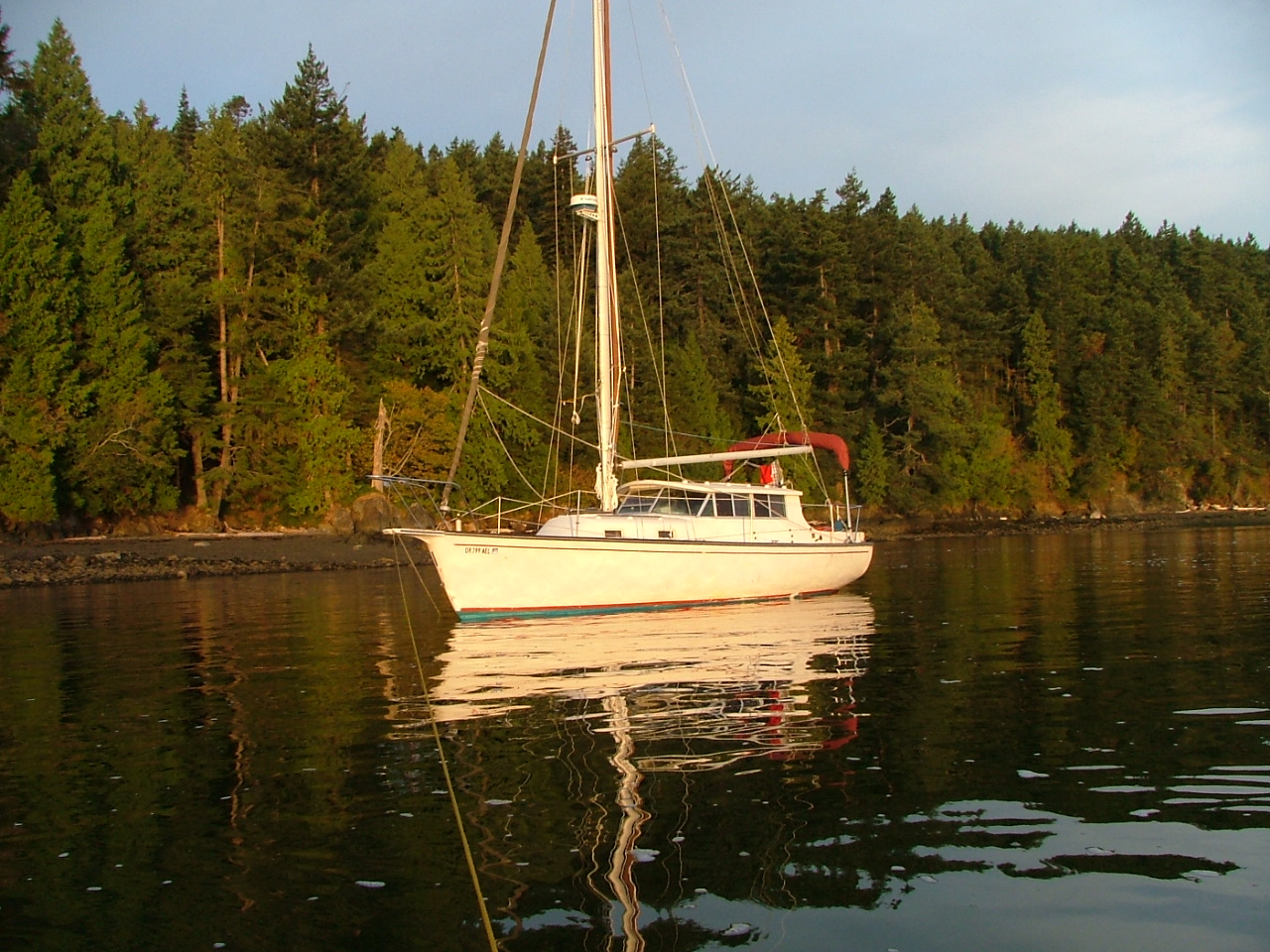
See the ferry approaching the anchored sailboat?
#4 Wind or lack of wind (sorry sailors)
OK, here's some bad news for sailors. The San Juans are not known for great sailing winds in July and August. Out in the straits (Haro, Rosario, Georgia, Juan De Fuca)
you may get some decent sailing, but inside the islands, don't bet on it.
Sailing in April rain with reefed main
#5 Crowd control (no worries)
Most likely you won't have any problems with crowds except on the 4th of July and Labor Day. The good side is that you will always find a place to anchor, even on holidays, the dinghy ride may just be a little longer for some. Most marinas take reservations and you may as well take them up on it, but you don't need to. I suggest you slow down a little and enjoy the freedom of not planning ahead, take one day at a time and see where you go. Lastly, because this area is so close to Bellingham and Anacortes many boaters are day boaters. At the end of the day they head for home, leaving some resorts and parks half empty, especially on weekend Sunday nights. Monday or Tuesday are good days to begin your outing if you want to be alone.
Fourth of July celebration in the San Juan Islands at Roche Harbor Resort
Roche Harbor 4th of July balloon contest for kids in dinghys
yes, there was room for more, lots more
Expenses
DNR buoys are free (Cypress Island) State Park buoys are $10, many park floats are 50 cents a foot, Marinas charge between 75 cents and $2 a foot. Gasoline is a little more expensive than on land, but not much more. Food, groceries, ice are just a little more than the mainland but very fair priced overall.
How many days to plan
Plan a minimum of four days, but up to two weeks depending on what you like to do. (I like to sit on the dock at Jones Island and read my book between naps and walks, then I make a campfire in a empty tent site and cook Kielbasa followed by a glass of wine. Then retire to my boat for a good nights sleep. The next day, do it again)
Salt Water
Salt water drys sticky and does not suds up well with soap, you will get it all over you and your boat, count on it. After a week you will look forward to a shower. Your boat will be covered with salt crystals. Most marinas have little water and don't want you washing your boat.
Squalicum Harbor in Bellingham has boat and trailer fresh water wash down hoses in the parking lot. You should use them each time you dunk your trailer.
Provisions
For the most part you will want to provision before you leave on the boat. Anacortes and Bellingham have all the big stores and each has a West Marine store. All the resorts and towns have grocery stores, if you drive a fast boat, supply's may be only minutes away, putt putt's should work a store visit into your circuit. I say circuit because most cruisers will follow a circle of some sort trying to hit many stops. We find that ice needs renewing after four days, so a stop over at Friday Harbor, Deer Harbor, Roche Harbor, Blakelys, or Orcas landing fills the bill. All these places except Orcas, have gas and showers. Showers will cost a handful of quarters so be quick or be poor. Cold showers are free. Lopez Village has free showers but no dock so you will need a dinghy.how to dinghy to Lopez village
Garbage
All the parks are pack it in and pack it out, the marinas have dumpsters. If you are new to boat camping you will find garbage to be a pain because you are not used to storing everything in your boat. Little things like empty water bottles suddenly take space you don't have. You must give careful thought to what you are bringing, and the garbage it will generate. We don't use disposable bottles, minimize pop consumption, and try to have campfires to burn burnable trash. It is against the law to toss anything, (even a apple core) in the water.
Animals
Your dogs must be on a leash, period, everywhere. Raccoon's are on all islands and will climb right into your boat or kayak in the day time if you let them. Deer are all over too, but they shy away, except on Jones Island where you can hand feed them.
Otters live under most floats and docks, they will crawl all over your boat, get into things and make a mess. Otters also will mark their territory by pooing on your stuff, dock lines are a favorite.
Bathrooms
All the parks have nice composting toilets, (each island mentioned for overnight is a park) the rangers service all parks on a regular basis. You will be pleasantly surprised at how clean the facilities are.
Where to go:
Your destination is simply that, its the journey getting there and the experiences on the way that make a trip a wonderful vacation. Try the links below for some Island Park descriptions.
Bring your cell phone and charger, bring at least a portable handheld marine radio, bring basic first aid kit, call the Coast Guard, they can be there pretty fast, or arrange for vessel assist on your credit card, bring a friend with a similar boat, then you can help each other.