• Discover boat-in spots from Sucia’s anchorages to the trails of Stuart and Jones Island
• Experience the Islands
• Visit bustling Friday and Roche Harbors
• Find serene, secret coves • Your adventure begins now!
New Feature
Below every post is a satellite view hot link - You may drag image to your area and/or use the plus button to zoom in all the way or click street view when enabled.
++++ ============================= All Posts Below
Current Posts Below Note: The first few posts below are for first timers and stay on top — New posts are scattered throughout the website — use the search box or look in archives on the left side to find your interests
My regular anchoring hole at Fisherman Bay is off to the side at the second turn of the entrance channel. I like to anchor there because it is a short dinghy run out to the public beach access for Lopez Village and is in a semi-wind shadow due to the small bluff on shore.
I am truly embarrassed to tell my part in this mini-story because I know better and still did everything wrong.
We arrived late in the afternoon after exploring Watmough Bay and the southern tip of Lopez.
It was close to low tide and the depth sounder where I lowered the anchor was reading eight feet. I let out all my chain rode (30') and cleated off in the first foot or two of nylon. Then I momentarily slipped Kraken into reverse for a few seconds until she began to pull some. The bow swung around and I am sure the anchor set because we came to an abrupt stop. We settled in, cooked stir-fry for dinner and watched movies.
During the night the tide came in and was back out in the morning.
We took the dinghy to the village. It was a minus tide and we had a terrible time pulling/dragging
the Livingston up over all the newly exposed slippery seaweed but we got it all the way to the driftwood and tied her to a big rock. We had a late lunch and stayed in Lopez village longer than planned. When we arrived back at the dinghy, water was lapping at the driftwood and she was half floating but still tied to the rock.
There was no struggle this time we simply shoved off and headed for Kraken except Kraken was not where I left her. Before panic could set in I spotted her several hundred feet further into Fisherman Bay, neatly tied to an old wood float. As we dinghied the last few feet I connected all the dots and realized how lucky I was. I had printed the week's tide tables, but never looked at them. If I had, I would have known there were king tides and minus tides all that week. I would have known there was nearly a fourteen-foot tide range that day. kraken had simply floated her anchor and away she went.
After getting everything shipshape, I cast off from our new temporary home and motored over to a lady on a nearby anchored boat and asked if she had caught Kraken. She said yes she had. I thanked her profusely, and as I did, I thought to myself, was I just dumb and lucky, or was I spending credits I had paid forward?
Click below to see a satellite view of Fisherman Bay Spit Preserve
What is the proper or correct way to anchor in crowded marine parks?
Proper anchoring etiquette means respecting space, setting your anchor correctly, and not interfering with other boats’ swing. First arrivals have priority, and newcomers must anchor clear or move on. In crowded areas, boaters may use bow and stern anchors to limit swing, but poor setup, loud behavior, or crowding others creates problems quickly or is at least bad manners.
Oh yeah! Everyone remembers when you anchored, you were the one saying eff'g this and eff'g that while instructing your crew in dealing with your short comings.
Yeah, we remember you calling your wife an idiot and moron. Idiot for not pushing you over the side tied to the anchor is more accurate.
Loud, obnoxious, boisterous, yelling and foul language are no way to announce your arrival to the anchorage. You should be on your good behavior, you will never get another chance to make that first impression.
It's entirely possible that there is no room where you want to anchor, and you have no choice but to move along to your second choice. You can't squeeze in where you wont fit, and if you do force the issue, and there is an incident causing damage, you will be responsible financially. I think most boaters are a forgiving and helpful bunch, but not if your an inconsiderate dweeb to begin with. Hint: Ask the other boaters already anchored for help in anchoring before you anchor in their yard. They may just move over a little to help you out.
The old adage first come first served is true when you anchor, meaning the guy there ahead of you has claim to his spot, and you need to respect his anchor location and swing of his boat. The guy that comes in after you will stay out of your way,
and so forth.
Stern anchor plus bow anchor:
Many hot spots will have more boats than can hang and swing safely so skippers have taken to hooking out both directions, and stretching the boat in the middle to limit swing, thereby cramming more boats in safely. This is perfectly acceptable provided the weather agrees. If you arrive in one of these places and don't follow suit you're being somewhat within your limited boater rights, however taking an exorbitant amount of room to anchor your yacht spoils the fun so you may not be invited to sun-downers. When it gets really crowded, skippers will raft boats together, usually anchoring just the biggest boats. Let the party begin.
Defensive boating
is just like in your car, you need to be prepared to move when a boat comes at you dragging its anchor. Watch others upstream of you when they anchor, if they don't have much scope out, or didn't set their anchor, watch out. Its better to move your boat in the daylight before they drag into you in the dark.
What about private anchor buoys?
Most of the harbors and resorts around the San Juan's have private buoys scattered around. You should leave them alone unless you have permission to use them. They may be not maintained and unsafe, the owner may show up after dark and tell you to leave. Emergency's are different, but your emergency may not matter to the owner.
Anchor lights:
If you're in an established anchorage, (all parks are ) you don't need to have a light, but if you think someone may run into you in the dark, turn it on, that's the smart call. We use a battery powered light run up a halyard, plus if we are on shore after dark, it makes finding the boat easier. It is disconcerting paddling the dinghy into the darkness and not being able to see your boat.
How do you set and secure your anchor properly for safe boating?
Proper anchoring is more than just tossing the anchor over the side — you need to pay out enough scope (rode), let the anchor dig in, test the set, and be ready to reset if it drags. By approaching the spot into wind/current, letting out 7–10 × the water depth before cleating, testing with reverse, and checking again, you greatly increase holding power and reduce dragging while cruising or overnighting
Anchoring your boat is easy, but if you don't follow basic rules, your pride and joy will float away.
Take a look below at # 1, when you lower your anchor, it will just be sitting there on the bottom, and that's not good enough for anything but the calmest most temporary of visits. To be secure, the anchor must be set by pulling it (blue arrow) sideways, # 2 with a little tugging by your boat, the points will dig in, creating a strong temporary home for your boat, # 3 & 4.
There can be an endless discussion about anchor types and anchoring techniques but for now, lets just help first timers get hooked.
Notice in the drawing below, the anchor line (rode) is laying on the bottom. When this vessel pulls on the rode it will dig the points in and stay put. If the rode were shorter, say almost straight up, any pulling would lift the anchor right out and you would be set free to drag somewhere bad. (rocks, or into another boat) So it is obvious that the longer the rode is, the better your anchor will set and stay set.
Drawing courtesy of West Marine
Okay, you have the basics, lets talk through what you do to anchor that monster.
Set the brake, turn towards the curb, leave it in reverse and tie the reins with a quick-release knot. Seriously, the boat should never get loose, period.
These familiar-sounding hints may work for cars and horses, but not boats.
Dock lines
are important, it seems like an obvious observation, but I’m astounded at how many
times I see boaters tying up as if they didn’t care about what may be their 1st
or 2nd most valuable possession,
spouses and children excluded of course (for some). Some skippers treat their vessels as if it
were a horse, just throw the line around the hitching rail and she be there,
arrr, when I come back must be their logic. In their defense, some of these cowboys have never had their boats anywhere but on their trailer, some may not have dock lines.
Enough with
the excuses, every secure boat needs four or more lines going from the boat to the
float.
I know, people make exceptions
sooner or later, such as, “It was just a five minute stop over to get ice, or
the water was so smooth,” that’s fine, you’re the skipper and it’s your call.
Four or more
huh? Let's see, one bow line, one stern line, one spring line to stop forward surges, one spring line to stop backward surges. More lines are needed for nasty
conditions, such as big swells hitting you all night and day, passing boat
wakes, high winds. The condition of your vessel or the docks puny cleats and deteriorating
condition are all clear signs that you may need more lines.
Learn from
others or suffer the expense of learning yourself is a good piece of
advice.
I have on one occasion experienced a brand new line chafe through and part in only one night while tied
to an exposed outside float. A new line that rubs on a smooth rounded fiberglass
gel coat will lose the battle in one night if it is snapped taught constantly
by your boats surging.Plus the gel coat will suffer in case anyone cares.
The answer is loose lines
Shock absorbing snubbers,
chafe protection padding or hoses, more lines for when the first one breaks, or
park somewhere else. Of course, for short time periods, you can order your crew
to stand there and hold the boat off while you buy the beer and ice.
Don't forget to have oversized fenders, but even that won't save your boat if you park somewhere you shouldn't.
Probably since before exploration, men have claimed ownership of just about everything above and below the surface of the ocean, and this includes the San Juan Islands.
The good news is that the arguments of who owns what and where are pretty much settled. The bad news is that, as a boater staring across the water at some desirable beach or mudflat (if there is such a thing) you don’t know what to do, or where to land.
For the most part, you may anchor anywhere you want, except vessel navigation channels and marked farms. It doesn't take much common sense to figure out not to anchor in the middle of a boat congested narrow thoroughfare, (marked or not) but some daydreamers will do just that.
Just because it’s legal to anchor doesn't make it a good idea.
You can walk most beaches, below the normal high water line, but many properties own the adjacent tidelands and may or may not be marked. Not all shorelines have beaches and so private land will extend to the water’s edge. Most of the dry land (above high water) is private and you will be trespassing if you come ashore and hike into the woods. Some landowners don’t care if you come ashore, and some do. Many will have signs that alert you to their wishes and you should respect their wishes. If it were me I would not anchor off shore from a sign that said no trespassing, why ruffle someone’s feathers by anchoring or walking in their backyard.
There are places, marked and some not marked, where seagrass has been damaged, and signs ask you to anchor elsewhere.
Who’s not for being an environmentalist? Just move along, there’s plenty of other places to drop a hook.
At resorts and marinas, (Roche, Friday, Deer, Rosario, Fishermans, etc, etc etc., you will usually see boats anchored nearby, just follow their lead and anchor your boat too. Ask someone where the dinghy dock is and go spend some money. You may be thinking, how long can I anchor and what’s the cost, so I remind you it’s public, it's free, and you can anchor as long as you want.
There are some exceptions, but we don’t need to discuss them now, or ever, so go have a good cruising day.
Where and how is there public access to Lummi Island?
Follow these simple instructions for getting to shore on Lummi Island at the only public access beach with highway access.
For some time I have advised cruisers to use Inati Bay on Lummi Island as a storm refuge and lunch stop, or a very convenient anchorage when they don't have time to make it back to Bellingham or Sucia.
If you have the time you should consider going ashore, but not at Inati Bay where all the land is private and only has a logging road at that.
About three miles north of Inati Bay is the Whatcom Chief Ferry terminal.
The tiny but speedy 25 car ferry makes several Hale Passage crossings every hour, so you will see it for sure.
Head for the ferry terminal and about one football field length north, anchor your boat in front of a long stairway leading up the bank. At the top of the stairs where the old car deck and ramp once was is a rustic wood deck, turned into a public park complete with picnic tables. All the pilings are gone, there is nothing left, your only landmark will be the stairway with the Beach Cafe in the background. Beach the dinghy, not forgetting the current and tides, offload the bikes and clamber up the stairs.
The local private anchor buoys are quite a ways from shore, suggesting thin water, you are well advised to follow their lead and anchor far off as well, unless your stay is short.
Across the street (Nugent Road) is the Beach Cafe, turn left, south on Nugent and it is 1300 feet (1/4 mi) to the Islander Grocery Store. (just past the current ferry terminal.)
Look for public stairs and Beach Cafe. Land your dinghy on slab rock or gravel at low tide.
Driftwood suggests high tide reaches to stairs.
Mt Baker across Hale Passage is a great backdrop.
That's it -- for bicyclists head left or right on Nugent Rd and circle the north end of Lummi. It is an easy (not too hilly) 7 mile loop that takes you around Migley Point, Legoe Bay, and West Shore Drive with sweeping vistas of Rosario Strait.
Some first mates may find the rule of twelfths handy when anchoring in the shallows off the stairway. Below is the link to refresh your memory of how it works. Don't forget that the current changes 180 degrees and may unhook you. I set two longish rode anchors (boat in the middle) before I take off for an extended time if I anticipate current shifts.
Boat camping gives you access to places you can’t reach any other way.
The rewards are access, mobility, scenery, quiet nights, and a sense of adventure.
Boat camping lets you reach remote coves, small islands, and marine parks that road travelers never see. You’re not competing with crowds—you’re going where only boaters can go.
I was ready to unleash a fiery rant about the absolute misery of car camping and the soulless monotony of tropical cruises—just to prove, once and for all, why boat camping is the superior way to vacation. But after letting the idea simmer for a bit, I had to admit the truth: I actually like car camping. And I won’t lie—lounging on a tropical cruise has its perks too. Maybe you feel the same way? There’s something undeniably appealing about a change of pace, a chance to hit the reset button, to escape from whatever it is we need escaping from. After all, isn’t that what life and adventure is really about?
So rather than list potential horrible road trip issues, let's concentrate on what a boat camping trip promises.
For starters, the cynic in me has already thought, "no promises."
OK, enhanced expectations: (satisfies me)
relaxation (doing nothing at all, nothing!)
change up in daily grind
play with boat, meet and hang with other boat people
be with friends and family
do a little hiking-fishing-sailing-reading-writing
We can make this list go on and on, but you get the gist.
Relaxation, or being stress-free, is key to a successful vacation, and worrying about where we will spend the night (on a road trip) is a major stress factor. You can say get a reservation, but there are many times, when reservations are not in the cards or severely limit what you do. On a boat there is always a place to anchor.
One major difference between car camping and boat camping that is lost to non-boaters is the freedom to come and go, anywhere, anytime, and never having to worry about a "sorry no vacancy sign" or the all-too-common "campground full sign."
When boat camping, there are no check-in or check-out times, there are no camp hosts, no registration clerks. Docks at parks have some common-sense rules but are not reserved, and first-come, gets it. You will never, and I stress this, "EVER"be sent away. Oh sure, it may be crowded somewhere from time to time, but there will always be room to anchor. (The dinghy rides just get a little longer) When boat camping, unlike a road trip, you never need to stress out over getting a place to stay. Just go, you will have a spot when you arrive, and you can count on it. However, if you (not me) must ruin things, you can stress out over arriving in the dark, or other dumb self-inflicted pain, but that's another discussion.
So, what is the best reason for going boat camping?
Easy, we go boat camping to relax and get away from
it all!
Click below to see satellite view of Fossil Bay, Sucia
How do you have a drama free 4th of July cruise in the San Juan Islands?
All great cruises have things in common.
planning and preparation
safety, comfort, and ambience
simple itineraries and activities
relaxing pace with friends and family
Our plan was to leave La Conner the morning of the fourth, and then stop for kayaking in Deception Pass.
Next, walk around Friday Harbor, grab some ice cream and make it to Roche about five o'clock.
Arriving at Roche we were not shocked or surprised that the place was really crowded.
Being a believer that you can always find room for one more boat, we took a quick tour of the rafting lines and decided to find a place to squeeze in out in the bay. After anchoring and checking out our swing and the swing of those around us I upped anchor and chose another nearby spot, this time very close to shore, but also with a better view. I set two hooks side by side to keep us off the near by rocks should the wind come up. One anchor would have been fine but I slept better for the extra five minutes' work.
The fireworks, as promised were very well done, the wind conveniently spun us around so that our cockpit faced the show and the smoke blew away from us. All in all no complaints.
This pic although lacking something, does convey it was sunset.
Our dinghy is the odd one with the cool wood seat and centerboard trunk.
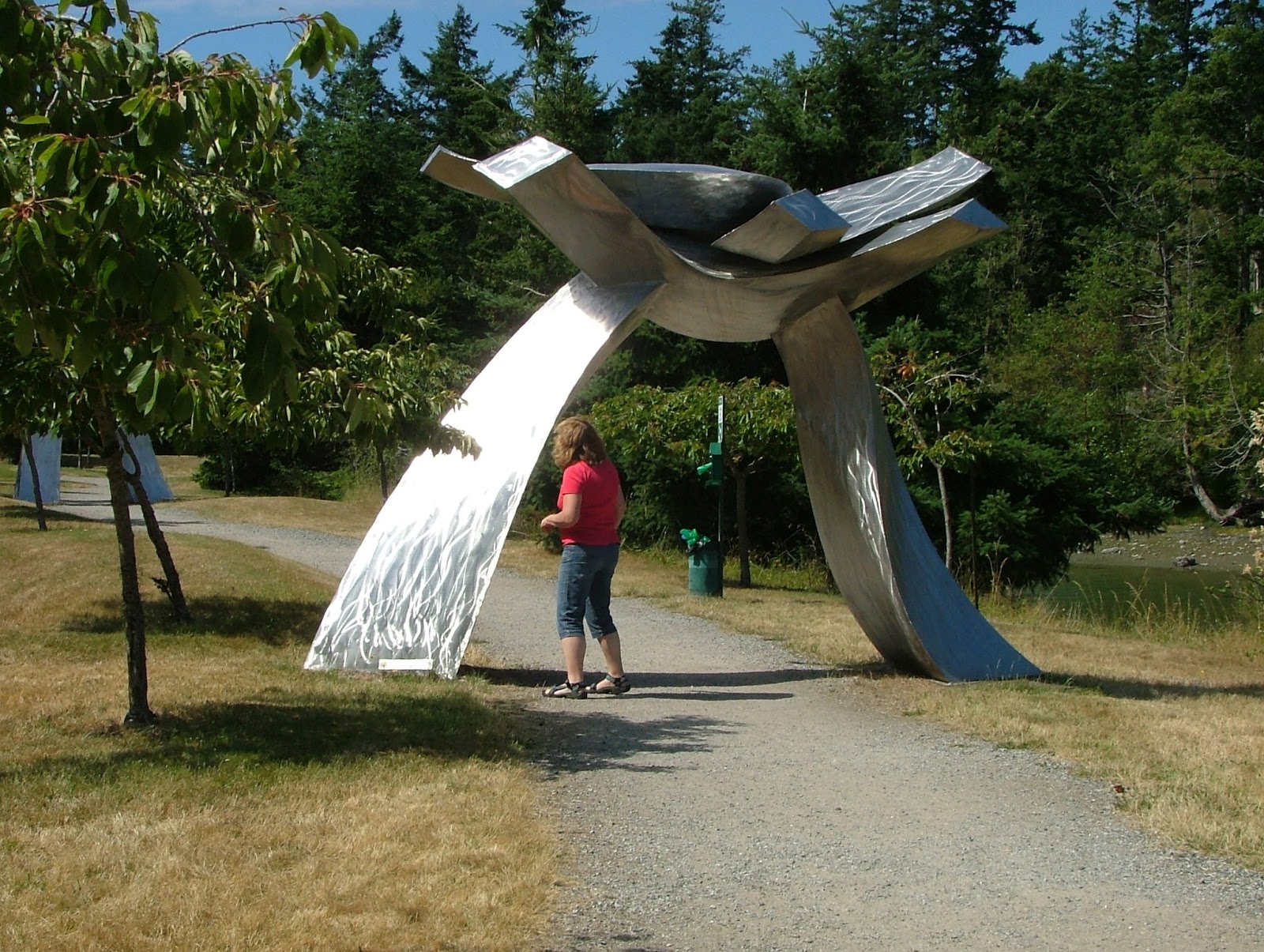
Roche sculpture along foot path by county dock
More sculpture
No rust, must be stainless steel.
Seeing a price tag with a sculpture brings out the art critic and connoisseur; feel free to purchase.
We finished the cruise with a stop over and hike at Stuart followed by a hot dog roast and windy night anchored at Jones.
The next day we ran over to hike and sail Sucia where we spent a rather noisy evening at the dock on Fossil Bay.
The fourth day, after a quick hike on Matia, and a drive by of the salmon pens at Deepwater Bay (Cypress), we were back at our slip in La Conner.
This was a pleasant, low key enjoyable little trip of about 110 miles.
(I really like my new laptop gps) read about laptop gps here
BTW, the news Wed. night (three days after arriving back home) was that one of the 85 foot for sale yachts we were all ogling on the fourth burned and sunk at the dock at Roche. It's really shocking (a little scary too) to see news pictures of a yacht you had just admired, and now sunk with just its charred stern above water next to the dock.
Click below to see a satellite view of Roche Harbor
The quick and easy answer is, "You need the same amount anywhere you go."
No help so far, okay, let's talk about a scenario that could be any of us.
You arrive at your first night's anchorage, a quiet little protected bay with a rocky bottom.
What a great vacation, hot dogs over a campfire onshore, some wine or beer, a really restful night's sleep, rich coffee in the morning, and then when you try to raise the anchor, your hooked to the biggest rock in the world. After hours of pulling from all directions, you finally give up and cut the line, ouch, 250 bucks worth of anchor and rode, gone. Oh well, you're not going to let a lost anchor spoil a perfect vacation and off you go to the next idyllic spot in the San Juan's.
Now it really hits home, the dock is full, no one offers to or wants to raft your boat. So you think, that's okay, I'll just go ashore in the dinghy, find an anchor-shaped rock, bring it back to the mother ship, and tie it to what's left of the cut rode. Except the rode is too short, and you need to stay on board to keep circling in the boat because no one in your crew (wife and children) is qualified to run the boat while you're rock hunting. So your current ex-spouse rows to shore, and .... see where this is going?
What should happen is you break out a spare anchor and rode that's stored and ready to deploy once you tie off the bitter end.
Your admiring first spouse and children think you're a hero.
OK, dinghy scenario. Your youngest children who have just mastered rowing are off somewhere nearby while you snooze or read a book. Little do you know, but they just lost both oars, and the wind is quickly
Click below to read more
In my opinion, being able to get to shore without getting wet feet is a big plus.
Rowing a short distance is high on my list, too.
Having a way to tie up the dinghy is very handy, but not a deal breaker.
Protection from wakes and rogue waves is obvious.
Pea gravel is much better than sand or rocks or sea grass.
Scroll to the bottom for my number one and number two choices when sailing the San Juan Islands
When planning a trip to the San Juan Islands, choosing the right dinghy beach can make or break your experience. At first, I was simply going to list key features of good dinghy beaches, but then I realized that newcomers might need a heads-up—not all "good" dinghy beaches are worth visiting, and some "bad" ones might still be worth a stop.
Why the Right Dinghy Beach Matters
Even if you plan to stay at a dock, remember that dock space in the San Juans is not reservable. More often than not, you’ll need to anchor and go ashore by dinghy—and if the beach isn’t dinghy-friendly, it could seriously impact or even ruin your visit.
Considerations for Different Activities
Camping – A poor landing spot could make unloading gear difficult or even dangerous.
Hiking – If you're leaving your dinghy for the entire day, you'll need to ensure it's safe from rising tides, strong currents, or theft.
Precautions – Some beaches require extra planning, such as a long rope, transport wheels, or even a chain and padlock to secure your dinghy properly.
Being prepared can make all the difference. A little foresight ensures that an inconvenient beach doesn’t turn into a major headache. Forewarned is forearmed!
In my opinion, a good dinghy beach simply allows you to get to shore and back to the boat with a minimum of fuss and bother, but there is a lot to consider
In no particular order, lets make a list of likes and dislikes.
not getting feet wet getting into and out of the dinghy is really nice.
ditto for all tide levels, so the angle (slope) of the beach is crucial
gravel versus mud is a no brain-er
sand is better than mud, but both track into the dinghy and back to the boat (gravel doesn't track)
something nearby to tie the painter to, like a massive old log
a cool view of my boat when I turn around
a nearby restroom is handy
not smelling like dead seaweed is a plus
fires permitted and driftwood is always nice for evenings
nearby tide pools for exploring
security is something some spots lack (theft of dinghy or contents)
free-roaming dogs! or other wildlife
how about a lack of bugs and bird droppings
what about a western view of the setting sun
protection from weather-driven waves and nasty wakes
click on -read more- to find my two best dinghy beach choices
What happens when your anchor drags in a crowded harbor like Roche Harbor?
Dragging an anchor creates a high-stakes emergency at Roche Harbor.
You don't, and I didn't, want to miss the Fourth of July at Roche Harbor
This was going to be the best boat trip ever. We are headed to Roche Harbor in the San Juan’s, where we will join in the fun, celebrating with 1,000’s of boaters from all over the Northwest and beyond. And it really was a great trip, just not the one expected. Roche Harbor (yes, pronounced “Roach”) is a destination resort for boaters and non-boaters alike, nestled on a fairly large protected bay on the northwest corner of San Juan Island in Washington State.
Our trip starts in Portland, OR, where we live. But our boat, a 28-foot sailboat, is moored for the summer in Anacortes, WA.
Having done this 275-mile drive many times, we have developed a system and are not in a hurry, after all, we are on vacation. We left Portland late in the morning, breezed through Seattle traffic, and arrived at Cap Sante Marina in Anacortes ready for dinner. The first thing we do is make sure “Windsong” is still floating in our slip and that the batteries are fully charged. After checking out the boat and stowing all our "must-have" gear and toys, we head for one of the many restaurants we have become familiar with. When we first started exploring Anacortes, some locals had recommended the bowling alley as the best place to get a good and sizable meal, and I can’t disagree, but we thankfully found that other places deserve our business as well, especially if some sort of ambiance is on your menu.
It usually takes all day on the road, and a meal in a strange city, before the kids start realizing we are off on another boat ride and start offering advice about what to stock up on for provisions.
Don’t forget coke and, chips and trail mix, cookies and hot dogs and everything else. So it’s decided once again that everyone will help with the shopping. After dinner, we parked in the parking lot at the top of the ramp leading to the boat, and we split up. I haul another load to the boat while the rest of my crew walks across the street to “Safeway.” Having a major grocery store nearby is a great benefit. By the time I get to the store, they have filled a cart with a week’s worth of really wonderful, great stuff. Where’s the fruit, wine, cheese, and M&M’s I want to know? It’s getting dark as we haul our loot across the street and down the long floating walkway to the boat. It’s never boring at a moorage, there is always someone to talk to, some weird, strange floating craft to look over, or something in the water to check out. We finally get everything packed away, “Windsong” is sitting much lower in the water, the children have staked out their overlapping territories, the moorage has become quiet, and we can hear muted conversation drifting across the calm water. It’s time to open a bottle of wine and relax in the cockpit, “no I say” You can’t have a coke, as I pull out the cork.
Morning comes early for me. As I wake up I think once again of a quote I read that went, “All boats under fifty feet are designed for just two people,” and I think to add, “and only if the two people are a couple.”
I slide the hatch open to see, not sunshine, but fog, which means grab a coat, everything is wet and cold. Hopefully, this is the last time I walk up the ramp today. Inside the Safeway is a Starbucks, where I purchase two steaming cups of strong black coffee. I really, really don’t like Starbucks coffee. A baker’s dozen donuts to go, and I’m back at the boat with breakfast. A quick final check of boat systems and I cast off, Linda is up, Jaiden and Kailey are still asleep, or at least they pretend to be asleep, the idling diesel motor is noisy, bangs, shakes, and rattles everything within its reach.
Windsong moves effortlessly through the still water, leaving no wake, at 1450 rpm the motor is smooth and without vibration. Time for coffee and donuts.
Roche Harbor is about 26 miles, six or seven hours of motoring, even longer, or not even possible if we sail. Today is the 3rd of July, and we plan to spend the night at Jones Island Marine Park. Normally, sailboat travel in the San Juan’s involves planning your trip around constantly changing tides and currents, which make a big difference in the time it takes to get somewhere and the fuel you use. But for us, this is the second day of our vacation, and we’re heading out regardless of the current. Almost immediately, we are swept into the outgoing tidal current and are whisked along at twice our normal speed. Ah, good planning, skipper. The fog is limiting our visibility as we cut across Rosario Strait heading for Thatcher Pass.
We don’t have radar and I don’t want to be near any ferries so I take a somewhat northerly course. Of course, now the current is pulling us sideways right into where I don’t want to be.
More good planning, skipper. We have a reliable GPS that will help keep us off the rocks. The fog is pea soup now, visibility is only a hundred feet or less. Just three or four times the length of the boat. We are essentially running blind. As we approach Thatcher Pass, I maneuver very close to the invisible shore. Everything is white, and I am dripping wet from condensing fog. What a great trip. We are constantly monitoring the depth sounder and GPS, staying in shallow water, we work our way further into the pass. The boat is moving slowly as we feel our way along. I’m glad the current is against us now or we would be pushed along faster than we could stop or turn should we need to. Our senses are acutely tuned to the situation at hand. I know the ferries can’t come this close to shore, my worry is other nuts like us groping blindly along. If we encounter a boat moving fast we will collide before we can take action.
Suddenly the fog begins turning more white and bright,
it is hurting our eyes.
In a matter of a few feet, we slip into a bright sunny day. Visibility is unlimited; we are a few hundred feet offshore. (too close) But no ferries.
The rest of the way to Jones Island is pretty routine. We pass by Friday Harbor, steer clear of several ferries, and lots of boats. All of Jones Island is a Washington State Park and my favorite place to visit.
The cove is protected, the dock is long enough for six or so boats, and there’s plenty of room to anchor. On shore the deer are friendly and some will let you pet them. There are campsites and fire pits, running water, toilets, and trails. Roche Harbor is just a short way further, we will leave around noon tomorrow, I want to get there in time to claim a good spot to anchor, and then dinghy to shore to visit the sculpture garden. The flag ceremony will be at sundown, for several years I have wanted to be at the flag lowering and watch the color guard. I know they fire a cannon as part of the ceremony.
We are in luck, a boat is pulling away from the dock as we enter the cove at Jones
Minutes later, “Windsong” ghosts up to the only spot available and we toss our lines to willing helpers on the dock. We are set for the night. Jaiden and Kailey head for some tide pools still exposed from low water.
Linda and I take off on the trail across the island, we see several deer in the woods. The campground on the other side of the island is used mostly by kayakers because it has no dock and the cove is not very big or protected. Sometimes we see groups huddled behind tarps trying to get out of the wind. We wonder if they know that they can paddle around to the other side where there is no wind at all and lots of great campsites. We pick a hand full of apples from the small orchard and walk back into the woods planning to feed the deer. The apples are not ripe, they are small and very hard. I’m not so sure they like them this early. As we walk back towards the cove we try to hand feed a deer but it shies away. I leave some cut up apple pieces on a log. The next day I see the apple pieces are still untouched, the raccoons must not be fond of tart fruit either. Sorry guys, All I have on the boat are M&M’s and chips. Jaiden and Kailey are busy on shore with some new friends, this is a good time to do some reading.
Tonight we have a campfire in one of the empty campsites and then sleep comes easy for everyone
It has been really exhausting doing nothing all day. In the morning I want to sleep in but the desire for my own coffee gets me up and soon we have our drip coffee maker happily sitting on the burner. It seems to take forever for the 12 cups to drip into the pot. At home we have a timer and the coffee is ready when I get up. This camping is cruel. Finally, cup in hand I walk down the dock, other boaters are up and about, and some are leaving for parts unknown. Some boat campers are onshore in tents. The dock has a spot designated for dinghies used by boaters that are anchored. Dinghy docks never have enough room so boaters just tie their dinghies as best they can. Windsong is tied up in a 30 minute parking/loading zone between the hours of 8:30 am to 3:30 pm. It’s getting close to 8:30 and one of my crew is nagging me to do something. Luckily the boat in front of us soon prepares to leave and as he pulls away from the dock I simply pull Windsong forward to the newly vacant space. “Happy?” I say to the crew. Now we can park for 14 days.
Today is the fourth of July, Roche Harbor is just a short distance from Jones Island. I’m sure that boats are already arriving at Roche by the hundreds, some will have reservations at the dock made a year in advance.
The over night fee is $1.50 per foot. Windsong would cost $45 per day but there’s not a chance in the world that space is available. Our plan is to anchor as close as possible so rowing the dinghy is not too hard or far. It’s time to go I decide, everyone that needs to go ashore better get going, we need to leave. Suddenly I’m in a rush, the anxiety of not knowing our accommodations at Roche has got me tensed up. This is not why I go boating. I’ve checked my current charts and tide predictions, but once again it doesn’t matter which way the water flows, we're on a mission, a quest. Hurry up, let's go I say again.
We must get to Roche Harbor and stake out our place to watch the fireworks, then go ashore for the flag ceremony.
Soon enough Windsong floats across the shallow shortcut on the east side of Pearl Island and we get a full view of the bay at Roche. Wow, what a sight, boats are everywhere. There must be a billion dollars worth of RV’s floating around us. I spot some Ocean Alexander yachts that I think sell for a million. (Years later I find out $15-20 million is more like it)
We see a motorized barge anchored with some warning buoys around it. That must be where the fireworks will be launched after dark tonight. We slowly motor around, taking stock of what is before us. I see, to the left of the massive rows of docks, several lines of boats rafting. There is a raft of about fifteen power boats lashed tight together, several rafts of three or four sailboats. Power boats and sailboats aren’t rafting together; it’s almost as if they don’t like each other. Dinghies are going to and fro, some fast, some slow, and many are overloaded to the point of ridiculous. At the end of one long raft is a gap about one hundred feet wide, and then lots of individual boats are anchored. It’s perfect for us. All the boats in this tight area are anchored fore and aft to keep them in line and from swinging into each other. We lower our plow anchor about seventy-five feet in front of where we want to be and slowly back up in our spot, paying out the anchor line as we go.
Not the fourth, just a busy weekend at Roche Harbor
At the right point, I cleat the line hard and keep powering back, setting the anchor by forcing the plow point into the bottom. When Windsong shudders to a stop, I give the throttle a little boost to make sure we're dug in well. While I hold the boat in reverse, keeping her in place, Kailey pushes off in the dinghy with a folding grapple anchor and a floating yellow line. I instruct her to paddle to shore and wedge the anchor between some large boulders. We now have secure lines out the front and out the back.
After turning off the motor, it’s a simple matter to pull the boat forward with the anchor line until we are in line with all the other boats. And then taking up the slack at the rear to make sure we don’t move sideways. This is how all the boats in the line are anchored; there are so many yellow lines going to shore that it would be impossible to paddle a dinghy behind the boats without losing your head. In front of the line of boats is a clear, unobstructed passageway with a steady stream of dinghies and yachts moving back and forth from the resort. We have about fifty feet on each side of us to the next boats. I motion a hello gesture to one group and get a resounding “Having a great party, do you need a drink?” response. The response from the guy in the stinkpot on the other side isn’t friendly; he acts like we invaded his space and thinks sailboats should be sunk. Kailey ties the dinghy to our swim platform, and we are set for another night, or so I think.
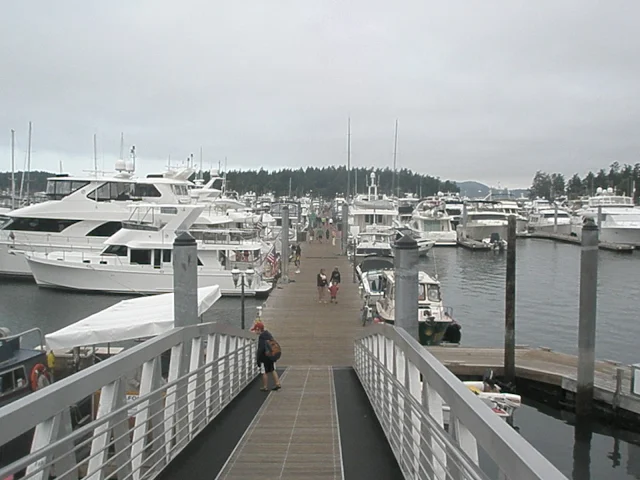
On shore at Roche Harbor are restaurants, a well-stocked grocery, half a dozen sidewalk booths selling local artist creations, snacks, and ice cream.
There are hiking trails, a swimming pool, and flower gardens that wedding groups use. A short hike up the hill takes you to the grass airplane landing strip and a forty acre sculpture garden. We all pile into the dinghy and paddle off. The dinghy dock at the main moorage is full so we head for the little dock by the swimming pool. On shore we are just in time to watch the blind dinghy race. I wish we would have been earlier to join in, it looks like a lot of fun. The “Blind Dinghy Race” has two people in each dinghy, the one paddling is blindfolded the other one yells directions. All the racers start at a open stretch of dock and paddle away when the start gun fires. They paddle under an overhead walkway lined with spectators. The racers try to avoid the pilings and then turn around and come back to the start dock. Oars are flying, people are screaming, "left, left no the other left, now right, right" dinghies are colliding. Someone eventually claims the prize. A little later in the afternoon is a children’s only, balloon capture. All the participants and their dinghies are in a small area surrounded by docks and cheering parents. At the start a large quantity of big balloons is dumped into the open water and the children try to collect as many as possible into their boats. The one with the most is the winner, but all the children receive prizes. Pandemonium ensues and the balloon capture quickly deteriorates into a free for all with several kids going over the side trying to get balloons. Even in July only the most hearty and fearless swim in the cold San Juan waters.
Childrens balloon capture at Roche Harbor
Eventually we stock up at the grocery store, buy some ice and head for the boat to have dinner. As daylight begins to slip away we are entertained by three Bald Eagles perched in the trees on shore behind our boats. The Eagles noiselessly glide down and snatch fish from the water and then with a few powerful wing beats are back in the trees. Repeatedly these majestic birds dodge dozens of taut yellow lines to grab a quick bite. Not once did I see an Eagle tangle with a line.
In about thirty minutes, the Roche Harbor staff will be lowering the flags and firing the cannon.
Several times in past years, circumstances or poor planning have caused me to miss the ceremony; finally, the stars have aligned for me, and on the fourth of July at that. This is a great trip. The kids will stay on the boat while Linda and I paddle ashore. I’m in the cockpit anxiously waiting to leave. When I look over at the unfriendly boat next to us, I sense that it looks different, it is about thirty-five feet long and fifteen feet tall at the flying bridge. I’m sure it gives the owner a sense of power looking down on our puny boat. The wind has been steadily increasing for the past hour and I suspect this boat is catching the wind and straining at the anchor lines, which would move it a little closer to us.
I ask Linda, ” Do you think that boat is getting closer?”
As I’m watching, I become sure it is half the distance it was. Now I know for sure, we have a problem; the boat is only ten feet away. There is nothing I can do. The other boat's anchor has broken out, and it is dragging into us, the last ten feet closes rapidly, and he is against us. I hold him off long enough to grab a fender and place it between us, saving us both from damage. I’m banging on his hull with my fist, trying to get their attention, but Linda tells me she saw them all leave earlier.
This is not good. Our ground tackle can’t hold us, plus a twenty-thousand-pound boat caught sideways in a rising wind.
His surface area alone is probably greater than all our sails. I know our 5/8” nylon anchor line will hold, but our 35-pound plow could break out at any second. Then I glance at our braided yellow stern line, oh boy, it is stretched to the breaking point. It is so tight that it is only half the diameter it’s supposed to be. The line was never intended to take this kind of load. I had bought an inexpensive floating line for dinghy work, not this. The wind is picking up; if our stern line parts or anchor breaks free we are going to have two boats crashing into the line of rafted boats on the other side of us. I yell over to the rafting good-time party people and tell them "I have a serious problem, soon to become their problem too." They immediately jump into a couple of inflatable dinghies and begin pushing against the wayward, captainless yacht, relieving the tension on Windsong. Kailey gets in our dinghy while I untie our yellow stern line and hand it to her with instructions to paddle towards shore, making sure to keep herself and the line out of the way.
I start the motor and weigh anchor when I hear "ka-boom" as the cannon roars and the color guard completes the flag ceremony on shore. Rats, I missed it again.
Meanwhile, the boys in the inflatable dinghies have boarded the runaway wind-blown boat and found the ignition keys. They start the engine, raise the useless weed and mud-coated anchor, and motor away with the dinghies following. Once they clear out, I circle Windsong around and anchor back in the same spot, only this time there is lots more room without the big boat. Kailey rows the stern line over and we are back in business.
The party boys return in their inflatable dinghies minus the big boat. Curious, I ask them, “What did you do with the boat?” They said, "We took it to the customs dock and left it tied it to the red-painted area marked customs only”
We never saw the boat or the less-than-friendly skipper again. Pretty soon a sailboat anchors in the now vacant space beside us and rows a stern line back to shore. Life has returned to normal, Linda and I decided not to go ashore since we had missed the flag ceremony once again. The fireworks would be starting soon and we didn’t want to miss them, after all, we had a front-row seat.
FYI, a year or so later, but not on the fourth, I finally was able to watch a flag ceremony, the cannon firing took me by surprise. Later that evening a couple got married and then jumped off the high dock in their wedding clothes. Another great trip.
Click below to see a satellite view of Roche Harbor
Is Rosario Resort the perfect starting point for exploring Mt. Constitution?
The ultimate Orcas Island experience pairs a relaxing rendezvous at Rosario Resort with an exhilarating drive or hike to the summit of Mt. Constitution for unmatched panoramic views.
Rosario Rendezvous 2010
The best cruise yet! I'm sitting in my home gazing out the window at my land locked nautical variation of a RV camper, (my boat on a trailer) I drift off and begin day dreaming again.
This must be the 100th time since New Years that I have imagined our upcoming summer cruise. The trip is planned for July right after the fourth and we are going to cruise the Washington San Juan Islands again.
This trip our focus will be whale watching, (the last trip was whale watching too), but we were sidetracked meeting up with our daughter at Rosario Resort on Orcas Island. As I remember we supplied the trailerable yacht, cheese and wine, she supplied the car that seats four, and two friends. It turns out we had no cell phone service so we were glad we had earlier made plans to meet this afternoon. The weather was pleasant, and balmy with hardly a breeze in the air. It’s just about sundown when they wave to us from the parking lot at Rosario.
Rosario marina and gas dock - anchor area to right out of picture
We leave “Sunshine” our 25 foot sailboat, tied to an anchor buoy. The three of us quickly paddle the dinghy ashore. Soon we are six in a Subaru that seats four.
I’m a happy camper I get a front seat, we are heading for the top of Mt Constitution, the highest point in the San Juan Islands. At about 2400 feet I expect to have a fantastic view and see a gorgeous sunset.
But, like whale watching, it was not meant to be. When we arrive at the summit, the sun has been blocked and was settling into a thick blanket of fog that seemed to cover the western half of the world, the temperature felt like it had dropped to minus 50 and the wind was a howling gale the likes of which only arctic explorers are capable of surviving. I was glad we didn’t walk from the boat as I had once planned, if the seven miles of winding uphill switchbacks didn’t kill me, I’m sure the elements would’ve done me in just the same.
We quickly scan the fog free remaining eastern views to spot Anacortes, Bellingham, Mt Baker, and Lummi Island. Ocean freighters and Ferries far below look like toys. The swirling currents of Rosario Strait are clearly visible.
South of us we can see the Strait of Juan De Fuca and one edge of the fog bank. The frigid cold wind is biting into us. It had never occurred to me to bring a coat. We soon leave Mt Constitution to the only other people around, two lonely cold but hardy tourists. Climbing back into the Subaru is the beginning of a fast and scary bobsled ride back to sea level. Coming down I don’t remember near so many switchbacks or how steep the road is. In minutes we are back at Rosario. I invite everyone out to the boat for wine and snacks.
It takes three dinghy trips to get the six of us on board, and it’s just about dark when we hang a dim flashlight from the backstay and break out a cheese and cracker assortment, along with a 1.5 liter bottle of fine (read cheap) Merlot.
Before long, we are lost in conversation and story telling. Jaiden enjoys being Sunshine’s wine and cracker steward. A second bottle of something just as red but decidedly different appears and the night is fast upon us. The darkness is almost total without the moon. even though the dock is only a short distance away, it can’t be seen, nor can the half dozen or so other boats anchored nearby. Eventually our daughter and her friends decide it’s time to leave and that our dinghy for three can take four of them in one trip.
After all, the water is flat calm and its not far to the dock, even if you can’t see it. Why not give it a try.
Freeboard is a relative term.
They carefully cast off and paddle in the direction of the dock; the silence is complete as we listen for problems. A few minutes later, our son reappears without his passengers. Linda and I are both relieved, even though we know they are quite capable, it’s still unnerving having your children paddle off into the darkness in a boat overloaded and only a few inches above the water. That night I slept very well indeed, I always do on board. . In the morning we go ashore to stretch our legs and check out the new sites.
In earlier years we have toured Rosario, so we skipped the mansion tour, didn’t play outdoor shuffleboard, skipped the swimming pool, and ignored the gardens where they hold weddings, but we did read the new Café's menu and decided we couldn’t afford to eat out.
In the little store, we noted the inflated price for a bottle of propane and felt we shouldn’t be cooking either. In the tourist souvenir section, I try really hard to find something I want enough to be willing to pay a premium for it, and finally settle on some postcards. Postcards are a good way of assuring I get quality pictures. In good time we step back into the warm morning sunshine and stroll the manicured Rosario lawns just in time to watch Jaiden petting a deer and scratch its head. After a while, I’m sure I must have said “it’s time to go” but it really wasn’t, it was time to stay.
Click below for a satellite view of Rosario Resort