• Discover boat-in spots from Sucia’s anchorages to the trails of Stuart and Jones Island
• Experience the Islands
• Visit bustling Friday and Roche Harbors
• Find serene, secret coves • Your adventure begins now!
New Feature
Below every post is a satellite view hot link - You may drag image to your area and/or use the plus button to zoom in all the way or click street view when enabled.
++++ ============================= All Posts Below
Current Posts Below Note: The first few posts below are for first timers and stay on top — New posts are scattered throughout the website — use the search box or look in archives on the left side to find your interests
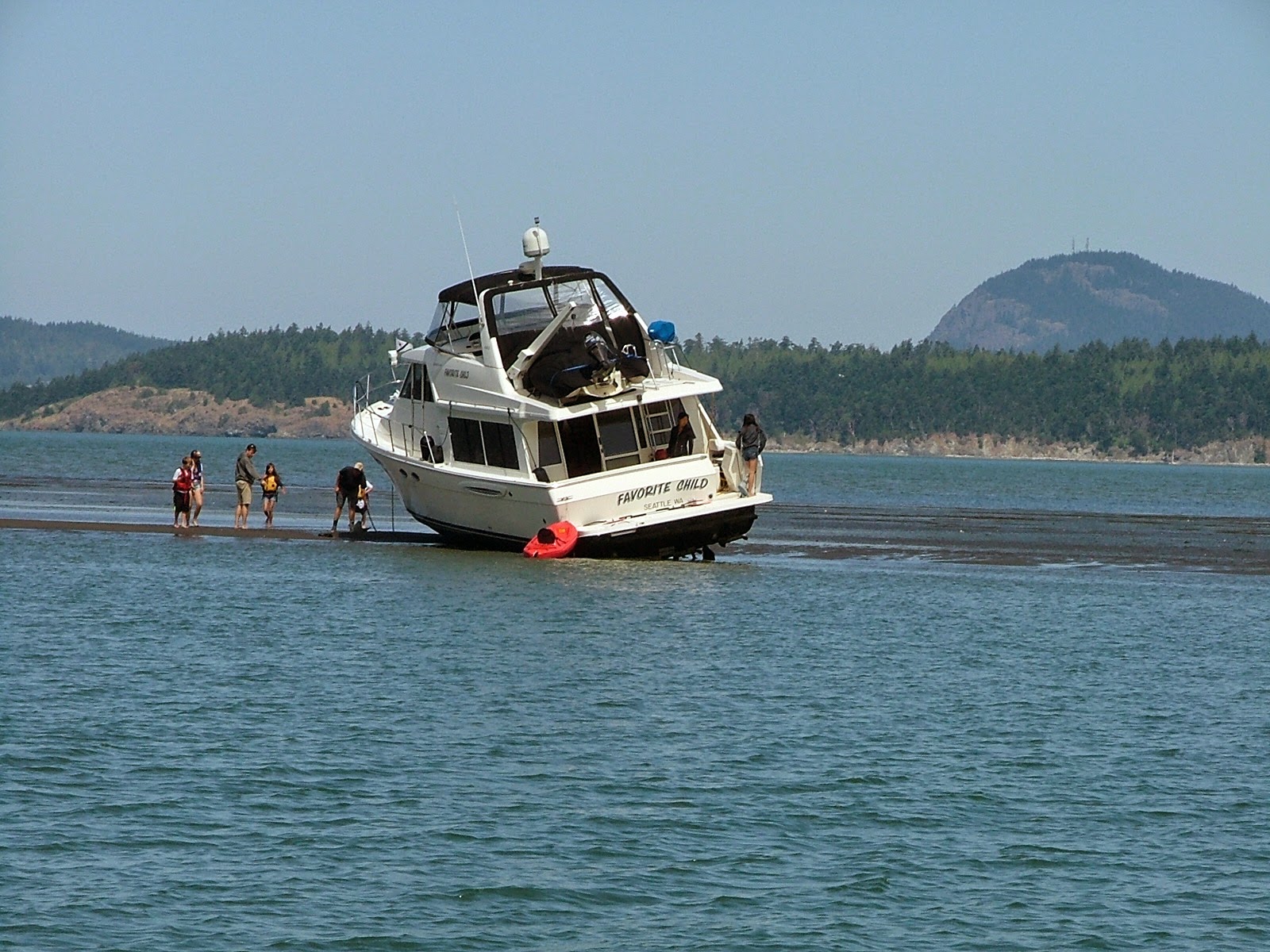
We came across this boat during our 4th of July hike to Fort Whitman on Goat Island.
They were barely stuck when we first saw them, but within a few minutes, it was clear they weren't getting off until the tide came back up. I can't imagine the port prop and shaft survived,
If this is you, our hearts go out to you. It must have been a rotten day. (make a comment, tell us what happened below, if you want to)
One of four gun emplacements at Fort Whitman on Goat Island.
Here is the link to the Fort Whitman posting > Fort Whitman - Goat Island
Click below to see a satellite view of Swinomish channel
I hope I can save someone else the expense that I just brought upon myself. Some of you will recognize yourselves, but others will think, "What an idiot, anyone knows that." So all of the latter can just run along. This tip is for newbies and those who simply forgot. (that's me)
This weekend I went exploring (gunkholing) in extremely thin murky water
. I was running slower than dead slow with the transmission in neutral except for little short one second shifts into gear to keep inching along.
The water was flat calm, which gave me confidence that I could simply back out, wrong thinking.
My thoughts were that if I bumped bottom, it would not matter at such a slow speed. I also figured that with the prop not spinning I couldn't possibly do any damage. Wrong, wrong, wrong. And I know from past lapses in memory, and errors in judgment that what happened could, and probably would, happen again. See Murphy's Law post.
I bumped at a speed much slower than I dock at
much, much slower, but with four and a half tons of mass, we slid and scraped before grinding to a stop. Then, as near as I can tell, the prop was on top of a rock, and even though it wasn't turning it still got a little bend in the brass right at the tip. It probably happened when I leaned over the transom looking for rocks After a close inspection, I found some fiberglass fibers exposed at several places along the bottom of the keel that need to be tucked in and repaired. So what should I have done? Easy, I should have anchored and jumped in the dinghy with oars. The problem was, in the murky water, I couldn't see rocks that were only two feet below the surface, but I didn't know that I couldn't see, until crunch. The other solution would be to quit gunkholing, and those of that persuasion know that it isn't going to happen soon.
So the advice is, Don't let your toys touch bottom. Or,
if you don't want to pay, don't play.
If you look closely, you can see the leading edge of the prop is wrinkled a little. Left over from my heating it and flattening the bend. My big keel apparently wasn't big enough to protect it from sitting on a rock.
Click below to see a satellite view of Olga on Orcas Island
Most of us have seen a derelict boat on shore somewhere, half-submerged, half part of the driftwood. Those boats are long past rising on a flood tide.
Let's think about when that boat went aground. Did the skipper intentionally run aground? Doubtful, maybe a storm, maybe mechanical failure, possibly. In all likelihood, someone made a decision or series of decisions that eventually led to grounding and eventual loss of the vessel. I suppose you are now thinking, that's so obvious, and your post is boring me, get to your point. Okay,
Okay, here is a real-life boating decision I made that others may relate to. When planning our departure time from Shelter Bay on Swinomish Channel, I consulted my tide forecasts, noting that low tide would be around noon. I also noted that numerous skippers have reported shoaling and groundings within the buoyed channel near Goat Island, where I was headed. So my decision was to delay departure and time my transit so that I would arrive at the problem area, at or after low tide.
Now, some may think that was dumb thinking, intentionally looking for thin water, and waiting until the water was the thinnest, of course, you are going to get into trouble. But they're wrong, I was thinking if I do run aground, the rising tide would soon release us, and away we go. If, on the other hand, we went ahead and left early and still ran aground on a falling tide, we could suffer damage as the water fell further, our stranded boat with its five-and-a-half-foot deep keel could tip over, and when the tide rose, we could down-flood before the boat righted and essentially become another derelict.
So my decision to wait a few hours may easily have resulted in another enjoyable outing, versus who knows!
Let's see, how does the saying go? "All skippers have run aground, or will run aground, and the rest are liars," or something like that.
While were on the subject of decisions and choices. I would be remiss if I didn't expand a little beyond driving my boat into the dirt, but I will avoid lecturing. You can just add your own thoughts while glancing over the list below.
Decisions and Choices we make
PFD's "life jackets," everyone has them, but do you insist on wearing them at certain times?
fire extinguishers?
anchors
routine maintenance
alcohol/drugs
Second skipper (huh), can others besides you run the boat when you fall overboard
checklist(s)
float plan
non-swimmers
handling fuel on board
first aid and medicines
emergency plan, supplies
Go or no go into poor conditions
wake or no wake (huh)
Try adding to this list, I'll bet you can.
It's October, and I'm going out this weekend. How about you?